
Concrete Mixing Plant Head-to-Head: Expressway vs High-Speed Railway On-Site Plants
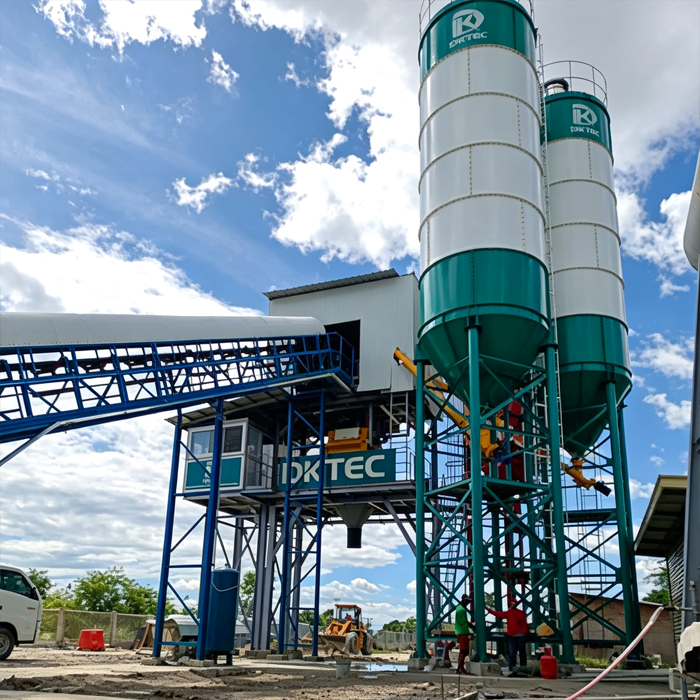
Cover: HZS180G engineering concrete batching plant — the higher-capacity end of the stationary configuration used for expressway project batching.
Short answer. When the binding constraint is uninterrupted output at a fixed chainage, the expressway configuration is the correct choice: it is specified for continuous operation, with seamless material flow on the aggregate side, ±1% metering for cement, mixing powder, water and additive against ±2% for aggregate, and layout adaptability to site conditions and discharge directions. When the binding constraint is high-grade mix accuracy plus fast, repeatable erection along a linear alignment, the high-speed railway configuration is the correct choice: it uses a four-level modular design with sub-module preassembly and integrated hoisting, and a control system built around automatic drop correction and dual-stage coarse/fine aggregate metering. Both are stationary in operation. Neither substitutes for the other.
Hangzhou Jusheng Machinery & Equipment Co., Ltd., which manufactures and exports under the DKTEC brand, builds both configurations inside one engineering concrete batching plant range. That makes the comparison unusually clean: the structural philosophy is shared, and the difference sits in how the plant is erected, how deeply the aggregate is metered, and how production continuity is engineered. This article works through those differences as a specification problem rather than a product preference.
The Real Problem: Four Constraints Decide, Not the Capacity Number
Two plants can publish the same theoretical productivity and still fail in completely different ways on site. In project batching, the deciding specification is rarely the headline cubic-metre figure. It is the interaction of four constraints that a capacity table will never show.
Installation sequence. The question is how much assembly work must happen at the site rather than in the factory, and whether the major structures arrive as liftable sub-modules or as steel sections to be bolted together. A plant with fewer site-installed components returns the site to the works earlier and consumes less crane and labour time during the window when the project needs concrete, not erection crews.
Modularity. The word is used loosely across the industry. What matters is what the module actually contains. The HZS60G documents a four-layer module design with sub-module preassembly and overall lifting, and states explicitly that the sub-module preassembly design reduces the number of components installed on site and shortens installation time. That is a measurable erection claim, not a marketing label.
Aggregate metering resolution. Across the engineering range, cement, mixing powder, water and additive are dosed at ±1%, while aggregate is dosed at ±2%. That asymmetry is where high-grade mixes are won or lost, because aggregate is the largest mass in the batch. Two levers decide the outcome: staged coarse/fine weighing on the mechanical side, and compensation on the control side — drop correction and pulse buckle control.
Production continuity. Continuity is a material-flow property before it is a control property. If aggregate spills at the transfer points or the feed stalls, the mixer starves regardless of how capable the batching computer is. The expressway configuration addresses this directly: seamless material flow technology prevents aggregate spillage, sustains continuous supply, and is documented as improving conveying efficiency by 20%.
Why Project-Specific Plants Dominate Infrastructure Batching
Concrete batching for infrastructure is a large market that remains organised around project specifics rather than around a single universal machine. The global concrete batch plants market was valued at USD 3.8 billion in 2024 (Global Market Insights). Asia-Pacific accounted for a 38% revenue share of that market in 2024 (Credence Research), and China alone exported USD 276.9 million of concrete or mortar mixers under HS 847431 in 2023, according to UN Comtrade data published through the World Bank WITS database. The pattern is consistent: manufacturing capacity is concentrated in Asia-Pacific, and the equipment travels to the project instead of the project travelling to the equipment.
That commercial geography is exactly why the expressway and high-speed railway briefs diverge. Both projects are linear, both are long, and both need concrete at the point of placement. What differs is which constraint is allowed to dominate: on an expressway programme the route advances and the mix catalogue changes with the pavement and structure schedule, so the plant must keep producing without interruption and must be able to follow the alignment; on a high-speed railway package the structural concrete grades are demanding and the alignment moves steadily, so metering resolution and repeatable erection become the governing requirements.
Shared vocabulary first. ISO 19720-1:2017 establishes terminology and commercial specifications for concrete mixing and batching plants. Using the standard's terms — theoretical productivity, nominal mixer capacity, weighing range and weighing accuracy — is the cheapest way to keep a two-configuration comparison honest, because it forces both offers onto the same four or five lines instead of two different brochures.
The engineering class matters. The engineering concrete batching plant category is documented around a design concept of “high precision, high strength and high adaptability,” described as used in high-speed railway, highway, bridge and airport works and as suitable for producing various grades of concrete. That single sentence explains why both configurations in this comparison come from the same family rather than from two unrelated product lines: the platform is shared, and the configuration is what changes.
Who builds them. Hangzhou Jusheng Machinery & Equipment Co., Ltd. is a Chinese manufacturer of complete concrete mixing plants and mining machinery lines, founded in 2015 and operating a 120,000 m² facility with 430 employees, an R&D team of 80 engineers and an annual output of 2,000 units. Around 80% of output is exported, to the Middle East, Southeast Asia, Africa, Europe, Central Asia, West Asia, Australia and South America, and the company moved from trading to robot-assisted production of mixing stations in 2017. Equipment is marketed under the DKTEC brand and documented at www.dongkunchina.com.
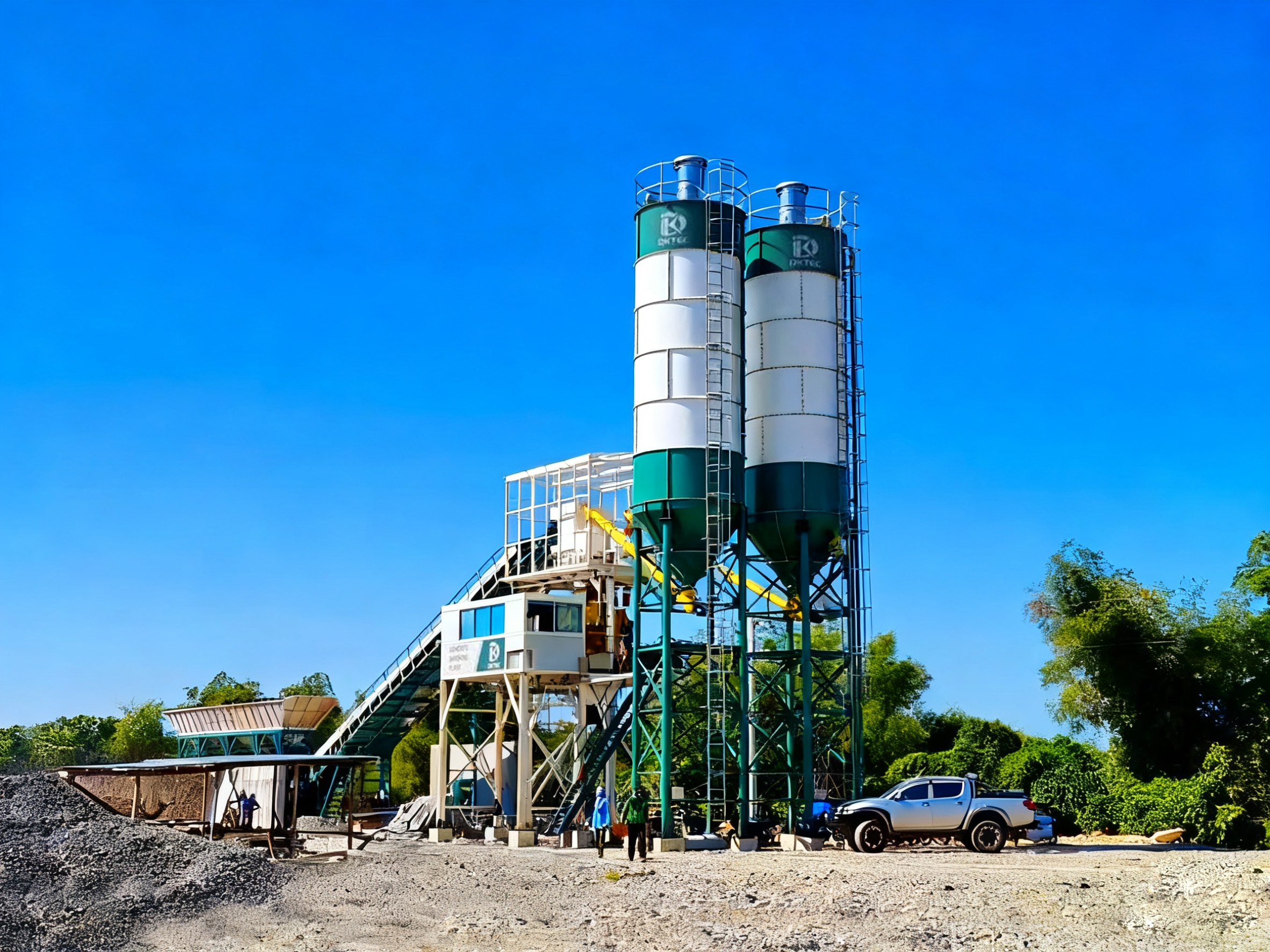
Stationary configuration: the mixing tower, aggregate batching station, inclined conveyor and control room are arranged around continuous production, with layout adapted to the site.
The Two Configurations, Side by Side
Configuration A — Stationary Plant for Expressway Project Batching
An expressway project batching plant is a stationary plant placed along the route to supply various grades of concrete to the works. It is designed around continuous operation, with modular assembly and disassembly so that it can be relocated as the route advances.
- Operating mode: stationary, modular quick assembly and disassembly for relocation, continuous production.
- Matched equipment: steel bin aggregate batching station, inclined belt conveyor, mixer, cement / mineral admixture / water / admixture metering systems, pneumatic system, main tower dust removal system, control room and electrical system; powder silo and screw conveyor are optional items.
- Metering: cement and powder ±1%, sand and gravel ±2%.
- Material flow: seamless material flow technology prevents aggregate spillage, ensures continuous supply and improves conveying efficiency by 20%.
- Layout: adaptable to various site conditions, plant layouts and discharge directions, and able to support multi-silo configurations.
A representative model is the HZS120G: 120 m³/h theoretical productivity, 210 kW installed capacity, a 2000 L twin-shaft forced mixer at 2×37 kW, and a discharge height of at least 3.8 m for direct loading into mixer trucks. It carries four 16 m³ aggregate bins with independent 2.0 m³ weighing hoppers, a double-door coarse-and-fine weighing structure with anti-fall protection and sand bin anti-blocking devices, and an 800 mm horizontal and inclined belt conveyor system with double-sided maintenance walkways and full-coverage guards. Dosing is ±2% for aggregate and ±1% for powders, water and admixture, supported by Keli load cells, AirTAC cylinders and SICOMA pneumatic butterfly valves, under fully automatic PLC control with recipe management, production reports and UPS power backup. Weighing ranges are 600–2000 kg aggregate, 200–1200 kg cement, 200–800 kg mixing powder, 150–400 kg water and 15–50 kg additive.
For a heavier route programme, the HZS180G raises theoretical productivity to 180 m³/h with a 3000 L mixer and 250 kW installed capacity, weighing aggregate at 900–3000 kg to ±2% and cement at 300–1800 kg to ±1%, with mixing powder at 200–1000 kg, water at 200–800 kg and additive at 15–80 kg. The HZS90G sits between them at 90 m³/h with a 1500 L mixer and 190 kW.
Configuration B — On-Site Plant for High-Speed Railway High-Grade Concrete
A high-speed railway on-site batching plant produces high-grade concrete at the works instead of hauling it, prioritising grade accuracy and repeatable erection along a linear alignment. It is stationary in operation, modular for relocation, and continuous in production.
- Control: a control system specialised for high-speed rail projects, with automatic correction of the drop and precise pulse-based weighing compensation.
- Metering: dual-stage coarse/fine aggregate metering and precision pulsating metering, documented as suitable for the production of various high-grade concrete types.
- Erection: a four-level modular design that allows for integrated hoisting and rapid installation.
- Matched equipment: steel bin batching station, inclined belt conveyor, mainstream high-end mixing unit, metering systems for cement / admixtures / water / additives, pneumatic system, main tower dust removal system, control room and electrical system; powder silos and screw conveyors are optional.
The documented model for this configuration is the HZS60G: 60 m³/h theoretical productivity, 100 kW installed capacity, a 1000 L twin-shaft forced mixer and a discharge height of at least 3.8 m. Its four-layer module design uses sub-module preassembly and overall lifting, which reduces the number of components installed on site and shortens installation time. The control system is high-speed-rail specific, applying automatic drop correction and pulse buckle control, with coarse and fine weighing pulse buckle weighing layered on top to reinforce measurement accuracy. Aggregate feeding runs in continuous feeding with seamless material flow, and an optional child screw is available for feeding control. Weighing ranges are 600–2500 kg aggregate to ±2%, 100–700 kg cement to ±1%, 80–250 kg water to ±1% and 8–20 kg additive to ±1%.
Where the pour schedule needs more volume, the engineering range extends to the HZS90G at 90 m³/h, the HZS120G at 120 m³/h and the HZS180G at 180 m³/h. The four-layer module design and the high-speed-rail-specific control logic are documented on the HZS60G, so the equivalent module and control arrangement for a larger model should be confirmed at specification stage rather than assumed from the nameplate.
Where the Trade-Offs Actually Land
Installation. The expressway plant keeps modular quick assembly and disassembly as its relocation mechanism, which suits a route that advances and a plant that may be pulled down and rebuilt. The high-speed railway plant front-loads the same work into the factory: sub-module preassembly plus overall lifting means fewer components are installed on site and the installation window is shorter. The decision rule is simple — if site labour and crane availability are the scarce resources, favour the four-level module approach; if the plant will be dismantled and re-erected several times, favour the configuration whose disassembly sequence is explicitly documented.
Modularity. Compare what is inside the module, not how many modules are listed. A preassembled sub-module that arrives as a liftable unit behaves differently from a set of structural members that must be assembled on the slab. On modular project plants, an optional steel structure foundation is also documented as reducing civil engineering cost, which matters on a linear alignment where foundations are repeated at every relocation.
Aggregate metering. Both configurations use staged weighing: the HZS120G specifies a double-door coarse-and-fine weighing structure, and the high-speed railway plant specifies dual-stage coarse/fine aggregate metering. The difference is the compensation logic wrapped around it. Aggregate is the largest mass in the batch and the hardest to stop accurately, because material is still in flight when the feed closes. Automatic drop correction and pulse buckle control exist to absorb that in-flight material, which is why the high-speed railway configuration treats control behaviour as part of the metering specification rather than as a separate automation upgrade.
Production continuity. On the expressway configuration, continuity is engineered on the conveyor side: seamless material flow, no spillage, continuous supply, 20% conveying efficiency gain. On the high-speed railway configuration, continuity is engineered at the batch level: precise pulse-based compensation keeps repeated high-grade batches inside tolerance, while the four-level module keeps the plant relocatable as the alignment moves. Same objective, two different places to spend the engineering budget.
How to Specify and Validate the Choice
- Name the governing constraint in one sentence. Write either “the plant must sustain continuous output at a fixed chainage with relocatable assembly” or “the plant must hold high-grade mix tolerance while being erected and re-erected along the alignment.” The sentence decides which configuration is being quoted.
- Size against the pour, not the plant. The engineering range runs from the HZS60G at 60 m³/h through the HZS90G at 90 m³/h and the HZS120G at 120 m³/h to the HZS180G at 180 m³/h, with installed capacity from 100 kW to 250 kW and nominal mixer capacity from 1000 L to 3000 L.
- Write the erection method into the RFQ. Ask for the layer count, which sub-modules are preassembled, which units are lifted whole, and how many components are installed on site. Without those four answers, “modular design” is not comparable between suppliers.
- Split metering into four lines. Aggregate range and ±2%; cement ±1%; mixing powder ±1%; water and additive ±1%. Then add the compensation requirement separately: coarse/fine staged weighing, pulse buckle control and automatic drop correction where high-grade mixes are specified.
- Lock material flow and dust control. Specify belt width and guarding, maintenance walkways, the main tower dust removal system, and whether powder silos and screw conveyors are in scope or optional. On the expressway configuration, state the required discharge directions and silo count so layout adaptability is priced, not assumed.
- Confirm control, documentation and support. Fully automatic PLC control with recipe management, production reports and UPS backup; OEM/ODM customization covering voltage and frequency, company logo, machine colour, appearance design and branding; 100% test before shipment; remote support and on-site installation; lead time 25–60 days at a minimum order quantity of one unit.
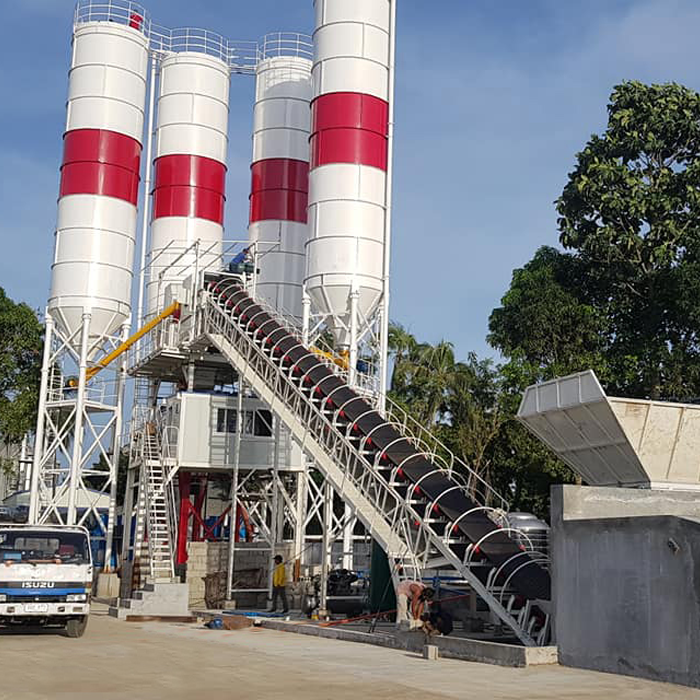
Parameter set on the stationary side: PLC control with industrial PC monitoring, ±2% aggregate weighing and ±1% for cement, water and additives, with a dust-proof control cabinet and emergency stop protection.
Where Each Configuration Fits
Expressway route with a moving paving front. The plant stays in continuous production while the mix catalogue changes, and the modular quick assembly and disassembly arrangement allows it to be relocated as the route advances. Multi-silo configurations and flexible discharge directions let the same plant serve different loading patterns without redesign.
High-speed railway section with demanding structural grades. The HZS60G configuration is the documented fit: four-level module design with integrated hoisting for rapid installation, dual-stage coarse/fine aggregate metering, and a high-speed-rail-specific control system applying automatic drop correction so that repeated high-grade batches stay inside tolerance while the plant follows the alignment.
Bridge packages. Bridge work needs high-strength, high-grade concrete at the pier and deck, so the same precision logic applies. The bridge-project configuration is documented with smooth internal vibration-assisted discharge and a robust hopper, an optional dual-auger system for precise feeding, and an optional steel structure foundation — features that matter when the discharge rhythm, not the headline capacity, limits the pour.
Airport and tight-schedule civil packages. Where the schedule is compressed and the pavement grades are strict, the modular plant arrangement allows rapid assembly and disassembly, the high-precision metering system supports consistent high-grade concrete, and the optional steel structure foundation reduces civil engineering cost.
Comparison Table: Expressway vs High-Speed Railway On-Site Plants
| Criterion | Expressway project plant (stationary) | High-speed railway on-site plant |
|---|---|---|
| Primary concrete duty | Various grades of concrete for expressway construction sites | High-precision, high-grade concrete produced locally on high-speed rail works |
| Operating mode | Stationary; continuous production; modular quick assembly and disassembly for relocation | Stationary; continuous production; modular, quick assembly and disassembly for relocation |
| Erection approach | Modular assembly and disassembly, layout adapted to site conditions | Four-level modular design with sub-module preassembly, integrated hoisting and rapid installation |
| Site installation workload | Reduced through modularity; discharge direction and silo count configurable | Reduced component count installed on site; installation time shortened |
| Aggregate metering | Coarse-and-fine weighing (double-door structure on HZS120G), ±2% | Dual-stage coarse/fine aggregate metering with pulse buckle weighing, ±2% |
| Powder, water, additive | ±1% across cement, mixing powder, water and additive | ±1% across cement, water and additive |
| Control logic | Fully automatic PLC with recipe management, production reports and UPS backup | High-speed-rail-specific control with automatic drop correction and pulse-based compensation |
| Material flow | Seamless material flow; no aggregate spillage; conveying efficiency +20% | Continuous feeding with seamless material flow; optional child screw for feed control |
| Documented model and output | HZS90G 90 m³/h; HZS120G 120 m³/h; HZS180G 180 m³/h | HZS60G 60 m³/h, documented with high-speed-rail control system |
| Dust and housing | Main tower dust removal system; control room; electrical system | Main tower dust removal system; control room; electrical system |
| Choose it when | Continuity, relocation along the route and layout flexibility dominate | Grade accuracy and fast, repeatable erection along a linear alignment dominate |
Frequently Asked Questions
How do I verify CE compliance when sourcing a stationary concrete batching plant from China?
CE marking is a supplier declaration against the applicable EU directives, so verification is a documentation and configuration exercise rather than a catalogue claim. Ask for the declaration of conformity and the technical file, confirm the electrical configuration matches the destination supply — DKTEC OEM/ODM customization covers voltage and frequency, company logo, machine colour, appearance design and branding — and check the safety features actually fitted, such as the emergency stop switches, anti-fall protection, dust-proof control cabinet and full-coverage belt guards specified on the HZS120. Factory test evidence matters too, since quality control is documented as 100% test. Specify with ISO 19720-1:2017 terminology so that competing offers are comparable line by line.
Can an expressway plant and a high-speed railway plant be built on the same platform?
Yes — both are engineered from the same engineering concrete batching plant base. That category is documented with a design concept of high precision, high strength and high adaptability, described as used in high-speed railway, highway, bridge and airport works, and suitable for producing various grades of concrete. The divergence is configuration-level: the high-speed railway plant adds a four-level module design with sub-module preassembly and overall lifting, a control system with automatic drop correction, and dual-stage coarse/fine aggregate metering; the expressway plant emphasises continuous operation, seamless material flow and adaptability to site conditions, plant layouts and discharge directions.
What drives the cost difference between the two configurations?
Cost is driven by five configuration decisions rather than by the plant category: the number of components installed on site, which is precisely what sub-module preassembly reduces; civil works, where an optional steel structure foundation is documented as reducing civil engineering cost on modular projects; the depth of the weighing package, meaning staged coarse/fine weighing plus compensation logic; the scope of the control system; and the silo and layout arrangement, since powder silos and screw conveyors are optional items on both configurations. Relocation frequency adds a sixth factor: a plant dismantled and re-erected several times across a route carries a different effective cost from one that stays in place for the whole programme.
What validation evidence can be requested before placing an order?
DKTEC accepts a minimum order quantity of one unit against a monthly capacity of 50 units, and every unit is subject to 100% test. A validation pack for either configuration should contain the model drawing, the weighing range and accuracy table for that specific model, the material-flow and dust-control arrangement, the control-system description, and a comparable reference — for example the HZS240 supplied to a large construction contractor in Oman for large-scale infrastructure work, documented for high-volume production, stable operation and consistent quality.
What is the lead time, and what determines the installation window?
Documented lead time is 25–60 days. The installation window is governed by the erection strategy specified: the four-level module design with sub-module preassembly reduces the number of components installed on site and shortens installation time, while modular quick assembly and disassembly keeps a plant relocatable as the alignment advances. Support after delivery is delivered as remote support and on-site installation.
Next Step: Configuration Review Before You Commit
Send the pour schedule, the mix grades and the site constraints, and DKTEC will confirm which configuration — expressway continuous operation or high-speed railway high-grade metering — the project actually needs, with the matching weighing table, module breakdown and control scope.
Download the full technical catalogue: DKTEC Concrete Batching Plant brochure (PDF)
Contact: Linder · linder@dongkunchina.com · Tel / WhatsApp +86 18888972181 · www.dongkunchina.com
Hangzhou Jusheng Machinery & Equipment Co., Ltd. — Zhongjiao Fortune Mansion, Gongshu District, Hangzhou, Zhejiang, China.
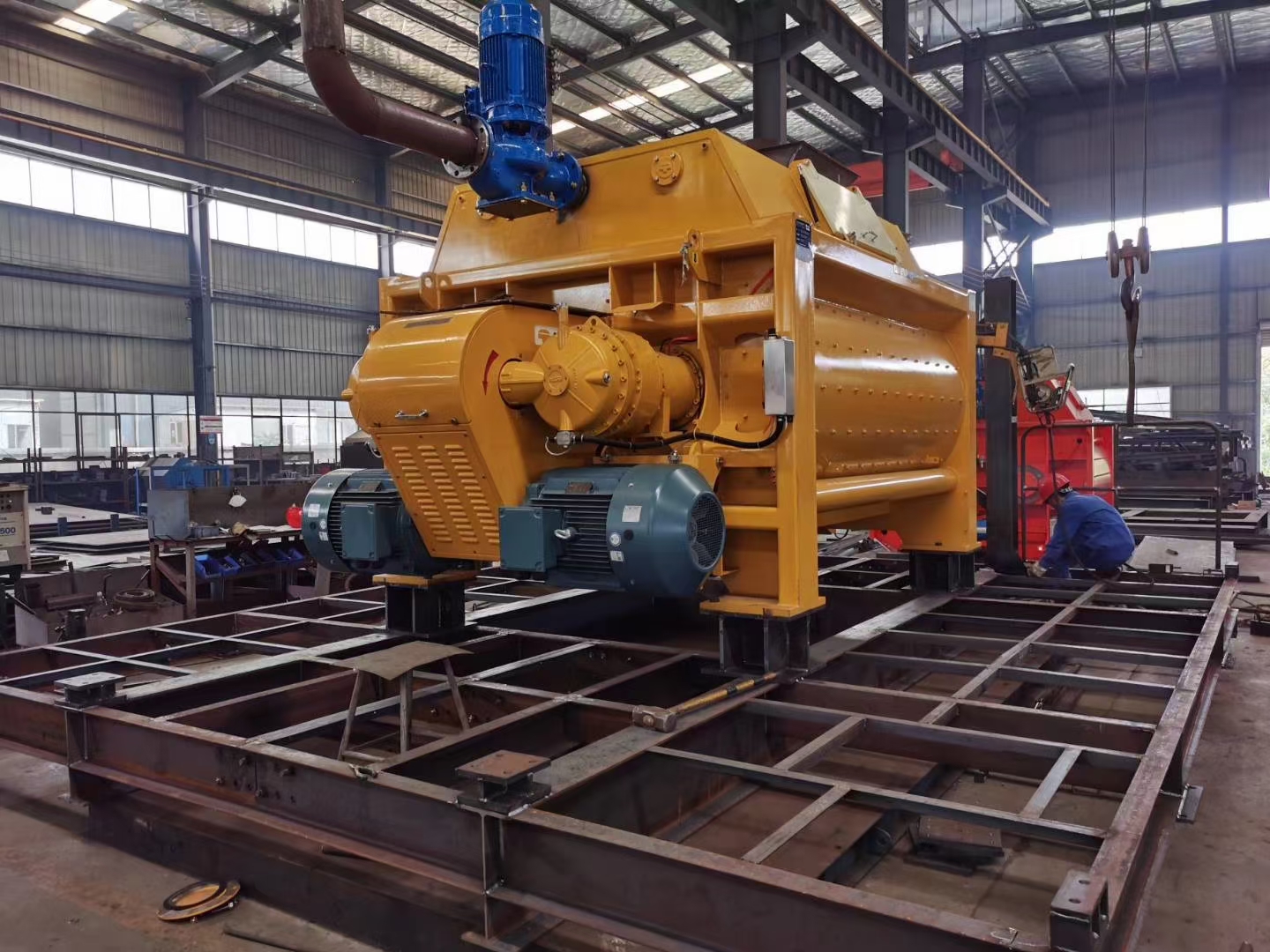
Factory review: 120,000 m² manufacturing base, 430 employees, 80 engineers and 2,000 units annual output, with 100% test before shipment.
Conclusion
The expressway and high-speed railway briefs are not two answers to the same question. The expressway configuration answers a continuity question: can the plant keep producing at a fixed chainage without starving the mixer, and can it be taken apart and rebuilt as the route advances? Its documented answers are continuous operation, seamless material flow with no aggregate spillage and a 20% conveying efficiency gain, ±1% metering on cement, mixing powder, water and additive against ±2% on aggregate, and layout adaptability across site conditions and discharge directions.
The high-speed railway configuration answers an accuracy and erection question: can the plant hold high-grade tolerance on repeated batches, and can it be erected quickly along a moving alignment? Its documented answers are a four-level modular design with sub-module preassembly and overall lifting, a high-speed-rail-specific control system with automatic drop correction, and dual-stage coarse/fine aggregate metering on a platform rated from 60 m³/h upward.
Both come from the same engineering concrete batching plant base, which is why the choice should be made on the four constraints — installation, modularity, aggregate metering and production continuity — rather than on the capacity number. Settle those four in the specification and the correct configuration selects itself.
Have Questions or Need More Details?
Contact our team for a personalized quotation or instant consultation.
Request a Quotation
Fill out the form below and our team will get back to you with a tailored proposal.
WhatsApp Direct Chat
Prefer to chat in real-time? Message us on WhatsApp for instant assistance & quick answers.
- Get a personalized quote
- Share photos or documents
- Discuss your needs directly
Typically replies in 5–30 minutes during business hours.