
Commercial vs Engineering Concrete Batching Plants: 7 Comparison Points Before You Commit
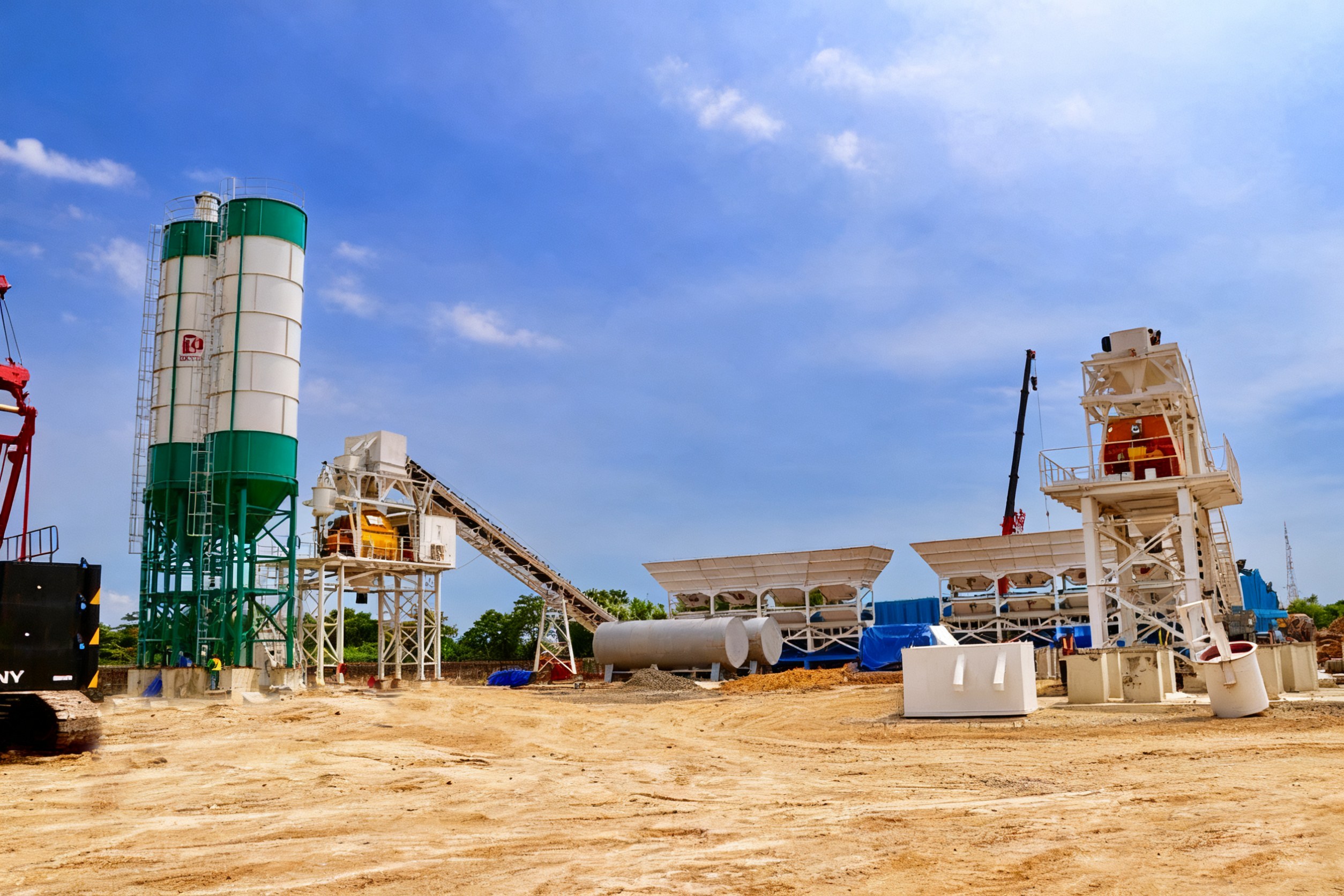
Commercial and engineering concrete batching plants share the same steel structure, the same twin-shaft mixing principle and the same ±1% / ±2% metering logic — yet they are built for different duty cycles. A commercial plant is sized to run continuously and push ready-mix concrete into a truck fleet. An engineering plant is sized to sit at the edge of a railway, highway or bridge section, produce high-grade concrete to a project specification, and then be dismantled and moved. The seven comparison points below are the ones that change a purchase decision, and each one ends with a commitment check you can paste into a technical annex before you sign.
Why the two categories get confused on a quotation sheet
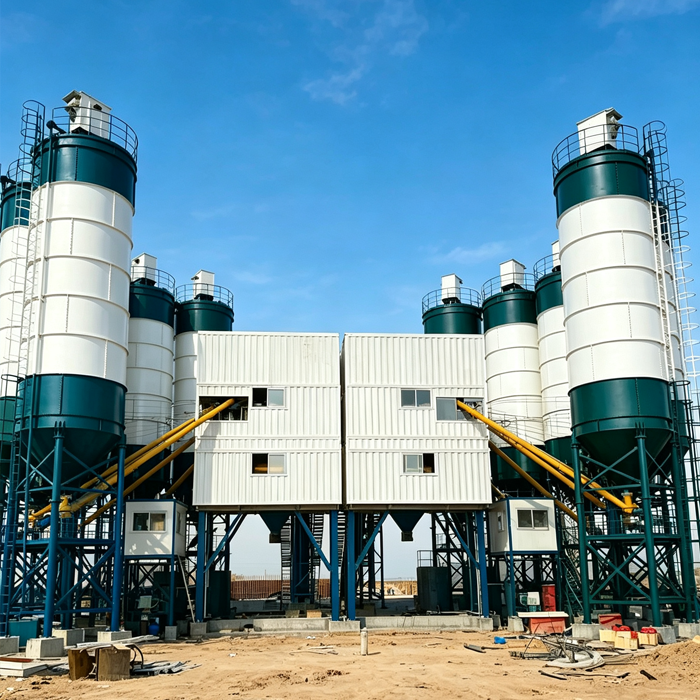
Put an HZS120 commercial plant and an HZS120G engineering plant side by side and the headline numbers are almost the same. Both are quoted at 120 m³/h theoretical productivity with 210 kW installed capacity, a 2000 L nominal mixer capacity and an unloading height of at least 3.8 m. Aggregate metering is ±2% across a 600–2000 kg range on both; cement is ±1% across 200–1200 kg; mixing powder ±1% across 200–800 kg.
The divergence sits in everything around the mixer. On the commercial HZS120, the aggregate side is documented as four 16 m³ silos with anti-blocking devices and 800 mm belt conveyors, with optional 150 t powder silos and φ273 mm / φ219 mm screw conveyors, and the control package includes emergency stop switches, anti-fall protection and a dust-proof control cabinet. On the engineering HZS120G, the same four 16 m³ bins carry independent 2.0 m³ weighing hoppers inside a double-door coarse-and-fine weighing structure, the 800 mm belts run horizontally and inclined with double-sided maintenance walkways, head water-flushing devices and full-coverage guards, and the mixer can be specified as an optional SICOMA, BHS or SDMIX 2000 L twin-shaft unit at 2 × 37 kW.
That is the trap. The figure a buyer compares first — cubic metres per hour — is the figure that differs least. The differences that cost money later appear on the layout drawing, the foundation drawing, the commissioning schedule and the compliance file.
Industry background: two duty models inside one market
Global Market Insights valued the global concrete batch plants market at USD 3.8 billion in 2024, and Credence Research attributes a 38% revenue share of that market to Asia-Pacific in the same year. Global Market Insights also reports that the infrastructure segment accounted for 39.4% of the mobile concrete batch plant market in 2024, which indicates that a meaningful share of demand is project-driven rather than permanent-facility-driven. UN Comtrade / WITS records USD 276.9 million of concrete or mortar mixers (HS 847431) exported from China in 2023 — the supply pool most international buyers are actually quoting from.
ISO 19720-1:2017 provides terminology and commercial specifications for concrete mixing and batching plants. That standard is useful for a practical reason: when two suppliers describe the same item in different words, a neutral vocabulary is what lets you compare the offers line by line instead of trusting the model name.
None of this data tells a buyer which family to purchase. It does show that both duty models are established, so the decision is a specification decision rather than a choice between a current and an outdated design.
Definitions: what each family is actually for
Commercial concrete batching plant
A commercial concrete batching plant is a stationary, continuously operating plant sized for ready-mix supply. In the DKTEC range the commercial family runs from the HZS120 at 120 m³/h and 210 kW through the HZS180 (180 m³/h, 250 kW) and HZS240 to the HZS270 and the HZS300 at 300 m³/h, 350 kW and 5000 L nominal capacity. The manufacturer positions this family for large and medium-sized commercial concrete customers, with the HZS300 as the highest-throughput model in the line-up.
Engineering concrete batching plant
An engineering concrete batching plant is a stationary plant engineered for on-site supply to a defined construction project — high-speed railway, expressway, bridge, airport or tunnel — with modular assembly and relocation designed in rather than added later. The DKTEC engineering family covers the HZS60G at 60 m³/h and 100 kW, the HZS90G at 90 m³/h and 190 kW, the HZS120G at 120 m³/h and 210 kW, and the HZS180G at 180 m³/h and 250 kW.
A third option: trailer-mounted mobile plants
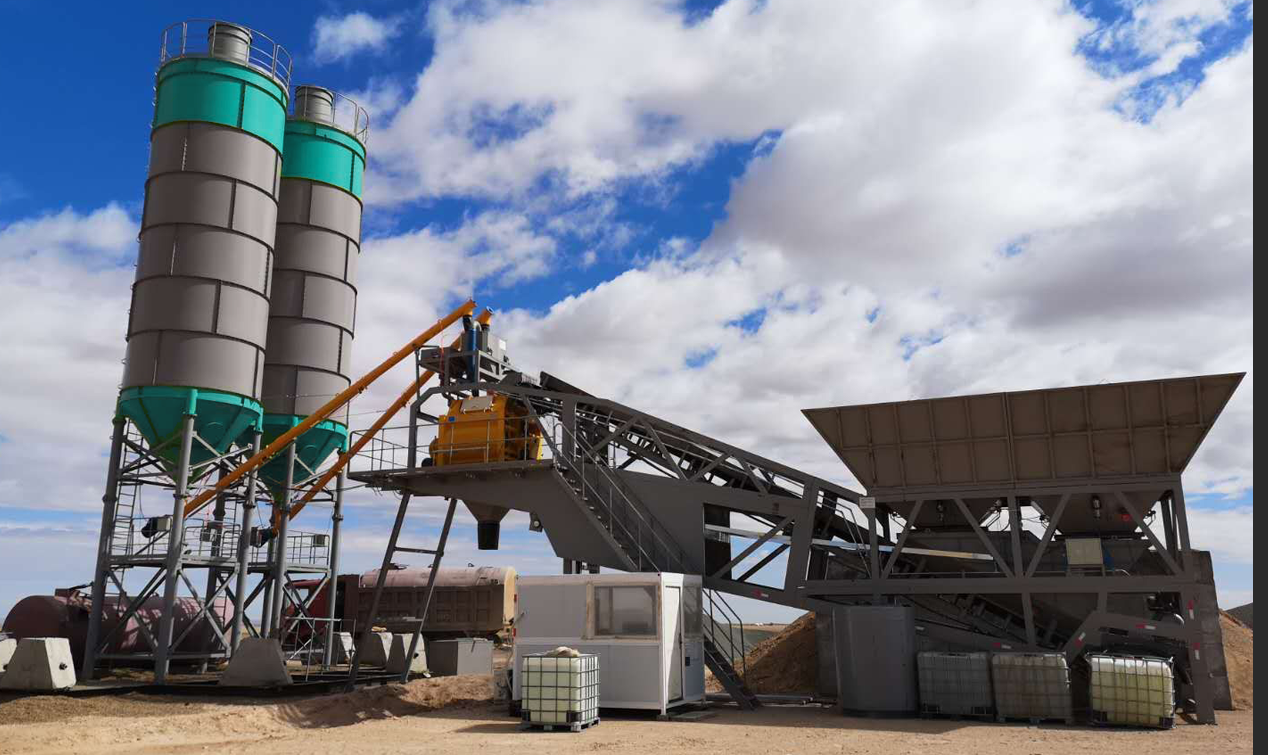
Where the site itself moves, the mobile line applies: HZS25Y at 25 m³/h with a 500 L mixer and 60 kW, HZS35Y at 35 m³/h with a 750 L mixer and 65 kW, HZS60Y at 60 m³/h with a 1000 L mixer and 100 kW, HZS90Y at 90 m³/h with a 1500 L mixer and 120 kW, and the HZS120Y. These units are mounted on an integrated trailer chassis, can be towed to site by a standard truck, need only a flat concrete surface with no deep foundations, and are documented at 3 days on-site commissioning.
Hangzhou Jusheng Machinery & Equipment Co., Ltd, which sells under the DKTEC brand, manufactures all three families. Company data lists a 120,000 m² factory, 430 employees, an 80-engineer R&D team and an annual output of 2000 units, with 80% of output exported across the Middle East, Southeast Asia, Africa, Europe, Central Asia, West Asia, Australia and South America. Its official company profile records a 2017 transition from trading to robot-assisted production of mixing stations.
Comparison point 1: output mode — continuous ready-mix versus campaign supply
The first decision is rhythm, not capacity. A commercial plant is specified to run continuously and hold a steady supply into a mixer-truck rotation; the HZS300's 300 m³/h theoretical output and 5000 L nominal capacity only pay back when the plant is scheduled across shifts. An engineering plant is specified around a placement programme: the HZS60G's 60 m³/h, the HZS90G's 90 m³/h and the HZS120G's 120 m³/h are matched to pour sizes and section progress, not to a permanent sales book.
Both families are documented as continuous-operation plants, so the word "continuous" alone does not separate them. What separates them is what happens when demand stops: a commercial plant loses revenue, while an engineering plant is either relocated or demobilised.
Installed capacity is the practical indicator of the electrical service you must provide. The engineering range spans 100–250 kW across HZS60G to HZS180G; the commercial range spans 210–350 kW across HZS120 to HZS300. These are nameplate figures, not consumption measurements, but they determine the supply, cabling and protection you must build before commissioning.
Comparison point 2: capacity and the metering envelope behind it
Both families hold the same accuracy classes: aggregate ±2%, and cement, mixing powder, water and additive ±1%. Where they differ is the weighing range, and the range is what constrains the mixes you can run.
- HZS120 (commercial): aggregate 600–2000 kg; cement 200–1200 kg; mixing powder 200–800 kg; water 150–500 kg; additive 15–50 kg.
- HZS180 (commercial): aggregate 900–3000 kg; cement 300–1800 kg; mixing powder 200–1000 kg; water 200–800 kg; additive 15–80 kg.
- HZS240 (commercial): aggregates up to 4500 kg per batch and cement up to 2500 kg, with ±2% aggregate and ±1% cement, powder, water and additive accuracy.
- HZS300 (commercial): aggregate 900–5000 kg; cement 400–2600 kg; mixing powder 300–1800 kg; water 200–1200 kg; additive 20–100 kg.
- HZS60G (engineering): aggregate 600–2500 kg; cement 100–700 kg; water 80–250 kg; additive 8–20 kg.
- HZS90G and HZS120G (engineering): aggregate 600–2000 kg; cement 200–1200 kg; mixing powder 200–800 kg; water 150–400 kg; additive 15–50 kg.
- HZS180G (engineering): aggregate 900–3000 kg; cement 300–1800 kg; mixing powder 200–1000 kg; water 200–800 kg; additive 15–80 kg.
The accuracy figure is a property of the weighing system; the range determines whether your batch sits comfortably inside the hopper's working envelope or presses against one end of it. A 400 kg cement batch is ordinary in an HZS60G (100–700 kg) and sits at the bottom of the HZS300's 400–2600 kg range. Neither is wrong, but only one of them is a designed operating point for that hopper — and that is the argument to settle before the purchase order, not during commissioning.
Comparison point 3: supporting equipment and plant layout
The aggregate batching station is the clearest physical difference between the two families, and it drives the civil works. For small-to-medium railway and highway work, the documented configuration is a steel bin aggregate batching station with four 10 m³ bins, an inclined belt conveyor using a 650 mm chevron belt with a rain cover, a 1 m³ twin-shaft mixer at 2 × 22 kW, cement / water / admixture metering systems, a pneumatic system, a main tower, a control room and the electrical system, with a 100 t powder silo and φ219 screw conveyor available as options. The same application record lists an optional steel-structure foundation, a sand silo anti-clogging device and a wear-resistant discharge hopper.
The commercial side runs larger aggregate storage and wider conveying. The HZS120 is documented with four 16 m³ aggregate silos with anti-blocking devices, 800 mm belt conveyors and optional 150 t powder silos with φ273 mm / φ219 mm screw conveyors. The HZS270 is documented with 30 m³ underground bunker and 1000 mm conveyor infrastructure, and the HZS300 matches that infrastructure while upgrading to 4.5 m³ weighing hoppers for faster batch cycling. Large-scale commercial bases may instead use an aggregate bin or ground-level bunker batching station with horizontal and inclined belt conveyors.
The layout consequence is the control room and the foundation. A steel bin station can be placed on an optional steel-structure foundation, which reduces civil works. An underground bunker positions aggregate below grade and therefore changes the earthworks scope on the same site. Both arrangements are legitimate; they are simply not interchangeable after the concrete has been poured.
Comparison point 4: modular pre-assembly and how fast the plant moves
Engineering plants are the ones designed to come apart. The HZS60G uses a four-layer module design with sub-module preassembly and overall lifting; the documented purpose is to reduce the number of components installed on site and shorten installation time. The railway and highway application record adds that the whole unit is modular, factory pre-assembled and assembled on site as modules, which is what enables rapid setup and relocation, supported by an optional steel-structure foundation.
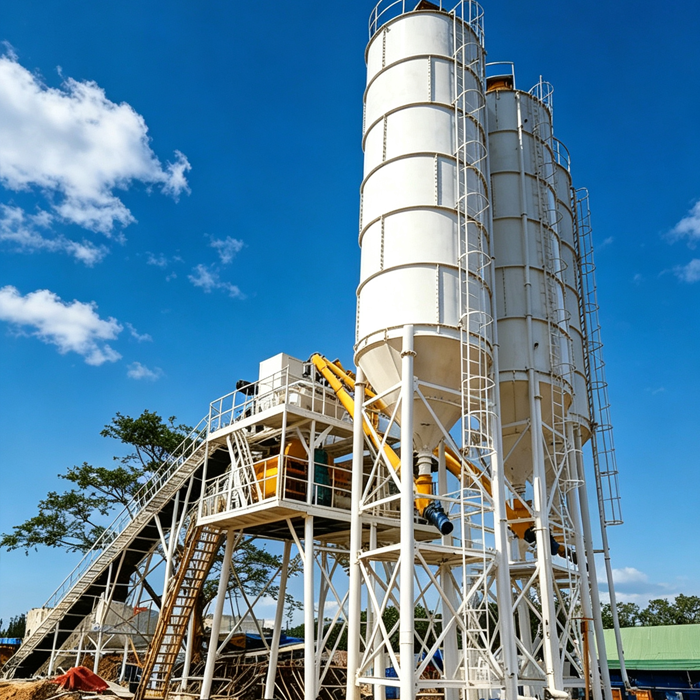
Commercial plants are modular as well, but for a different reason. In the commercial application record, the modular design with factory pre-assembly is credited with cutting on-site installation workload by 20% — a first-installation benefit rather than a relocation promise.
If relocation is the actual requirement, the trailer-mounted line is a different answer again. The HZS60Y is built on an integrated trailer chassis, can be towed to site by a standard truck, requires only a flat concrete surface with no deep foundations, and is documented at 3 days on-site commissioning. Its metering is ±2% for aggregate across 400–2000 kg and ±1% for cement, water and additive.
Comparison point 5: material flow and discharge reliability
Seamless material flow technology appears in the documentation for both families, and it is described consistently: aggregate does not sprinkle, feeding is continuous, and conveying efficiency increases by 20%. The statement appears on the HZS60G engineering plant, in the expressway application record and in the commercial ready-mix application record, so it is a shared design feature rather than a differentiator on its own.
The discharge end is where the families separate in practice. On large-scale commercial bases, the dual-pivot internal vibration structure is documented as improving vibration efficiency by 20% and resolving discharge problems with manufactured sand, fine sand and mineral powder. The engineering plant documents internal vibration with smooth cutting and a durable bucket body, plus an optional child screw for feeding control.
Weighing control is the other half of the flow question. The HZS60G's high-speed-rail-specific control system applies automatic correction of the drop and pulse-buckle control with coarse-and-fine weighing, so the feeder reacts to what the hopper is actually receiving rather than to a fixed time signal. On the commercial side, the HZS120 uses a PLC-based system with an industrial PC and a 24-inch LCD monitoring screen, and the HZS270 a PLC system for centralised operation and real-time production monitoring.
Comparison point 6: enclosure, dust and noise
This is where the commercial configuration currently carries more documented hardware. On the extra-large commercial layout, a fully enclosed standby hopper is documented as reducing open surface area by 75%, combined with a forced-cleaning membrane bag filter to improve dust removal performance. The HZS180's fully enclosed structure is documented with pulse dust removal and low-noise transmission; the mixing main building carries a pulse-jet dust collector and a fly ash return screw; the HZS120 includes a dust-proof control cabinet. On the large-scale commercial base, a screw-type air compressor developed for mixing-plant conditions is documented with dust protection and 20 dB noise reduction, and a low-pressure powder conveying system is available as an option to lower cement temperature and keep feeding continuous.
Engineering plants address the same issue through the project specification rather than the base configuration. The railway, highway, bridge and airport application records list a main tower dust removal system as part of the matched equipment, and the small-to-medium configuration specifies an inclined belt conveyor with a rain cover — which matters for both dust suppression and aggregate moisture on an exposed site.
Optional intelligent functions belong to the same discussion because they are usually sold alongside environmental equipment: online slump monitoring via mixer motor current curves, and smart powder silo level monitoring with ±2% inventory accuracy on the commercial ready-mix configuration; dual-plant control and smart silo level monitoring on the extra-large commercial configuration; and a one-operator, dual-plant control option on the large-scale commercial configuration, documented as reducing labour cost by 50%.
Comparison point 7: documentation, compliance evidence and commercial terms
Both families should arrive with the same class of paperwork, and this is the point most often left vague. Start from the standard: ISO 19720-1:2017 sets out terminology and commercial specifications for concrete mixing and batching plants, and it gives you neutral language for the quotation — what counts as theoretical productivity, what is inside the plant scope, and how components are named. Then bind the numbers. The accuracy classes (±2% aggregate; ±1% cement, mixing powder, water and additive) mean little without the weighing range attached, so require both on the datasheet and in the contract.
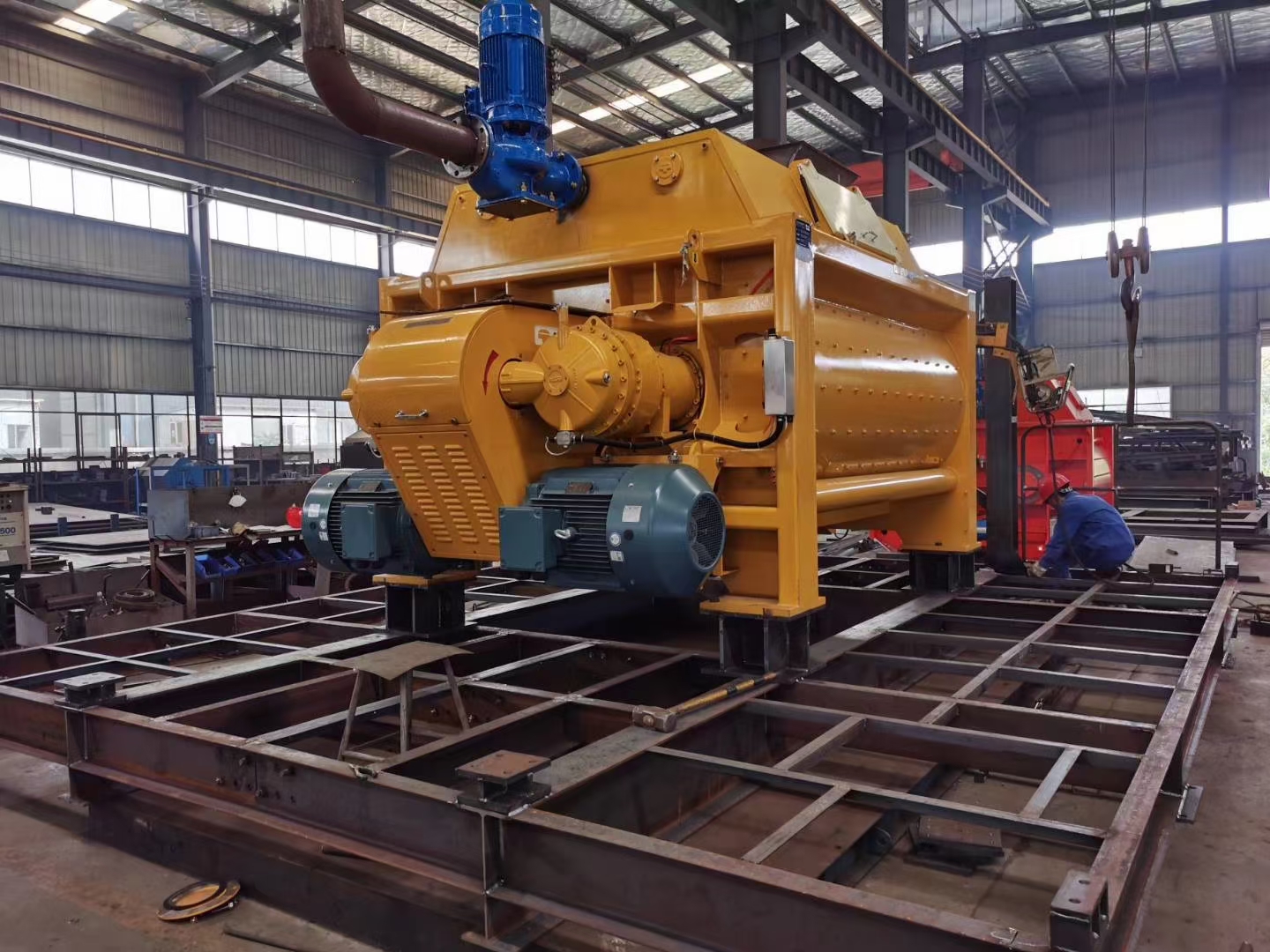
On the supply side, Hangzhou Jusheng Machinery & Equipment Co., Ltd lists 100% testing, a monthly capacity of 50 units, a lead time of 25–60 days and a minimum order of 1 unit, with OEM/ODM customisation covering voltage and frequency, company logo, machine colour, appearance design and branding, plus remote support and on-site installation after delivery. Those are the commercial levers to confirm in writing. Voltage and frequency customisation in particular defines the electrical interface the plant is built to, which is the difference between a straightforward connection and a retrofit.
The seven points in one table
| Comparison point | Commercial concrete batching plant | Engineering concrete batching plant |
|---|---|---|
| Primary duty | Continuous high-volume ready-mix supply into a truck fleet | On-site supply for a defined railway, highway, bridge, airport or tunnel project |
| DKTEC models | HZS120, HZS180, HZS240, HZS270, HZS300 | HZS60G, HZS90G, HZS120G, HZS180G |
| Theoretical productivity / installed capacity | 120–300 m³/h; 210–350 kW | 60–180 m³/h; 100–250 kW |
| Nominal mixer capacity | 2000–5000 L | 1000–3000 L |
| Metering accuracy | Aggregate ±2%; cement, mixing powder, water, additive ±1% | Aggregate ±2%; cement, mixing powder, water, additive ±1% |
| Aggregate weighing range (examples) | HZS120 600–2000 kg; HZS300 900–5000 kg | HZS60G 600–2500 kg; HZS180G 900–3000 kg |
| Aggregate supply | Four 16 m³ silos (HZS120); 30 m³ underground bunker with 1000 mm conveyor infrastructure (HZS270/HZS300); ground-level bunker option | Steel bin aggregate batching station, 10 m³ × 4 bins, on small-to-medium railway and highway work |
| Conveying | 800 mm belt conveyors (HZS120); 1000 mm conveyor infrastructure (HZS270/HZS300) | 650 mm chevron belt with rain cover (small-to-medium); 800 mm horizontal and inclined belts with double-sided walkways (HZS120G) |
| Assembly | Modular design with factory pre-assembly; on-site installation workload cut by 20% | Four-layer module design, sub-module preassembly, overall lifting |
| Relocation | Modular for first installation; relocation not the design purpose | Whole-unit modular design for rapid setup and relocation |
| Dust and enclosure | Fully enclosed standby hopper (75% open-surface reduction) with forced-cleaning membrane bag filter; pulse dust removal and low-noise transmission (HZS180); dust-proof control cabinet (HZS120) | Main tower dust removal system in matched equipment; rain cover on the inclined belt conveyor |
| Control | PLC with industrial PC and 24-inch LCD monitoring (HZS120); PLC centralised operation and real-time monitoring (HZS270) | High-speed-rail-specific control with automatic drop correction and pulse-buckle weighing (HZS60G) |
| Reference standard | ISO 19720-1:2017 terminology and commercial specifications | ISO 19720-1:2017 terminology and commercial specifications |
Matching the plant to the project: documented configurations
Ready-mix production for a city or industrial base. A ready-mixed concrete company in Indonesia operates three units — HZS180, HZS300 and HZS120 — recorded with stable operation and consistent concrete quality over a 10–15 year duration. A large construction contractor in Indonesia runs a single HZS300 for large-scale infrastructure, recorded at 300 m³/h with high-efficiency mixing, precise weighing and reliable performance. In Oman, a contractor's HZS240 is recorded for large-scale infrastructure with 240 m³/h capacity, efficient mixing and precise weighing.
Bridge and structural work. A concrete supplier in the Philippines uses an HZS180 for bridge engineering — pile foundations, pile caps, piers, abutments and girder bodies — recorded with a 5-year duration, high productivity, low failure rate and convenient maintenance. This is the pattern to note: the plant is chosen for a structural package, and the metering envelope is what protects beam and pier quality.
Engineering equipment serving commercial supply. The same Philippine market record includes a ready-mix supplier running two HZS90G engineering plants for commercial concrete production, with stable operation and consistent quality. That record shows the boundary is not absolute: an engineering plant can serve commercial supply when capacity and metering envelope fit, and the deciding factors then become relocation, foundation scope and enclosure rather than category.
Frequent relocation. Where the site moves between segments, the trailer-mounted line applies: HZS60Y at 60 m³/h with a 1000 L twin-shaft forced mixer, ±2% aggregate and ±1% cement, water and additive accuracy, towed by a standard truck and commissioned in 3 days on a flat concrete surface.
Frequently asked questions
Which China stationary concrete batching plant manufacturers with CE compliance should buyers evaluate?
CE marking on a concrete batching plant is a manufacturer's declaration supported by a technical file, so the evidence to request is a declaration of conformity that names the exact model and the standards it is declared against, plus the supporting test and design documentation. Verify three things: the legal manufacturer named on the declaration is the entity you are contracting with; the model designation on the declaration matches the model on the quotation (HZS120 and HZS120G are different models, even though both are quoted at 120 m³/h and 210 kW); and the electrical configuration matches your market. Hangzhou Jusheng Machinery & Equipment Co., Ltd lists 100% testing and Europe among its export markets, and it customises voltage and frequency, logo, colour, appearance and branding under OEM/ODM scope; the compliance file itself should be requested for the specific model and destination market rather than inferred from a brand statement.
What is the main difference between a commercial and an engineering concrete batching plant?
Output mode and installation logic. Commercial plants — HZS120 to HZS300, covering 120–300 m³/h and 210–350 kW — are built for continuous ready-mix supply with larger aggregate storage and wider conveying. Engineering plants — HZS60G to HZS180G, covering 60–180 m³/h and 100–250 kW — are built for on-site supply to a defined railway, highway, bridge or airport project, with four-layer modular pre-assembly and relocation designed in. Both families hold the same accuracy classes: ±2% for aggregate and ±1% for cement, mixing powder, water and additive.
Can an engineering concrete batching plant be relocated, and how long does that take?
Relocation is a design property of the engineering family: the HZS60G uses a four-layer module design with sub-module preassembly and overall lifting, and the railway and highway configuration is documented as modular, factory pre-assembled and assembled on site as modules for rapid setup and relocation, with an optional steel-structure foundation to reduce civil works. The explicit day figure in the available documentation belongs to the mobile line — 3 days on-site commissioning for the HZS60Y on a flat concrete surface with no deep foundations. For a stationary engineering plant, request the module count, crane plan and commissioning schedule rather than a single headline day figure.
What metering accuracy and weighing range should be written into the contract?
Specify both, material by material: ±2% for aggregate and ±1% for cement, mixing powder, water and additive, each with its declared range. Examples: the HZS120 commercial plant meters aggregate at 600–2000 kg and cement at 200–1200 kg; the HZS300 at 900–5000 kg and 400–2600 kg; the HZS60G engineering plant at 600–2500 kg aggregate and 100–700 kg cement, with water at 80–250 kg and additive at 8–20 kg. Accuracy without a range does not tell you whether your batch weights are inside the hopper's designed working envelope.
What lead time and minimum order should a buyer plan for?
The supplier's listed terms are a minimum order of 1 unit and a lead time of 25–60 days against a monthly capacity of 50 units, with remote support and on-site installation after delivery, and OEM/ODM customisation of voltage and frequency, logo, colour, appearance and branding. Treat the 25–60 days as the production window and plan freight, foundation works and commissioning separately: the mobile line's documented on-site commissioning is 3 days, while a stationary plant should be scheduled from the module and foundation drawings. To review a configuration against your own mix design or project programme, the DKTEC catalogue is available for download and the team can be reached at linder@dongkunchina.com.
Conclusion: commit to the duty cycle, not the headline output
The decision rule is short. If the plant must sell concrete continuously, choose the commercial family and size it on your heaviest mix inside the declared weighing range — not on the m³/h figure alone. If the plant must serve a railway, highway, bridge or airport section and then move, choose the engineering family and write the module count, foundation scope and relocation terms into the contract. If the site itself moves between segments, look at the trailer-mounted line.
Across all three routes, the seven commitment checks do the work that a specification sheet cannot: they force the metering range, the aggregate batching station, the assembly method, the discharge arrangement, the enclosure scope and the compliance file into the document that governs delivery. A plant that fits its duty cycle is an asset for the life of the project; a plant that only fits a quotation headline becomes a commissioning problem.
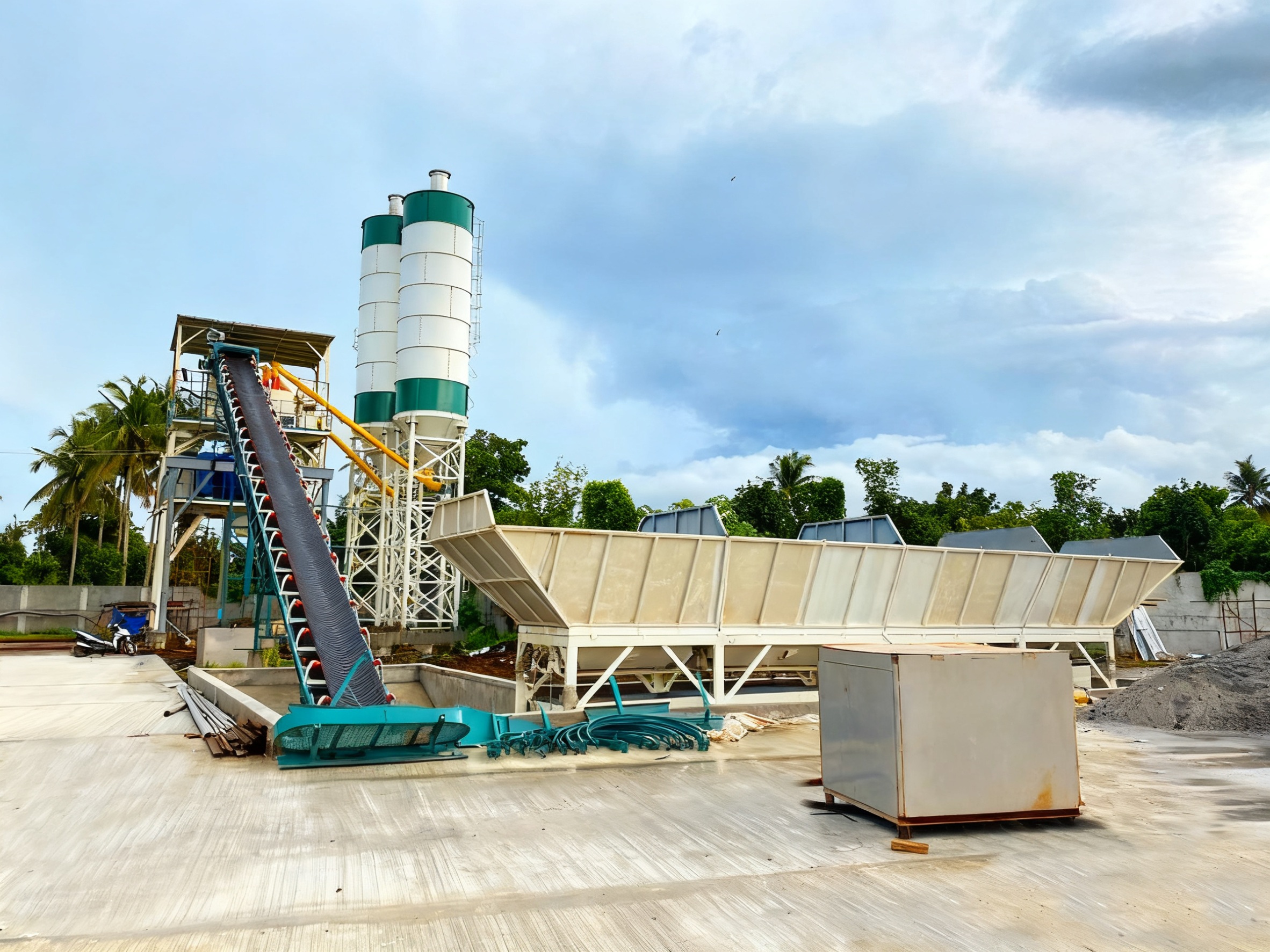
DKTEC, operated by Hangzhou Jusheng Machinery & Equipment Co., Ltd, manufactures the commercial HZS120–HZS300 range, the engineering HZS60G–HZS180G range and the mobile HZS25Y–HZS120Y range. Full model and parameter data is in the DKTEC concrete batching plant catalogue (PDF), and company information is published at www.dongkunchina.com.
Have Questions or Need More Details?
Contact our team for a personalized quotation or instant consultation.
Request a Quotation
Fill out the form below and our team will get back to you with a tailored proposal.
WhatsApp Direct Chat
Prefer to chat in real-time? Message us on WhatsApp for instant assistance & quick answers.
- Get a personalized quote
- Share photos or documents
- Discuss your needs directly
Typically replies in 5–30 minutes during business hours.