
Steel Bin vs Ground-Level Aggregate Batching Station for Concrete Mixing Plants
The choice between a steel bin aggregate batching station and a ground-level aggregate batching station is a layout decision, not a capacity contest. The steel bin layout stores aggregate in raised bins and usually feeds the mixer by inclined belt conveyor. The ground-level layout receives aggregate at grade, often with aggregate bins or a ground bunker, and uses horizontal plus inclined belt conveyors to reach the mixer. For buyers, the practical question is which material-flow path fits the site, the project type, the civil-work plan and the installation sequence.
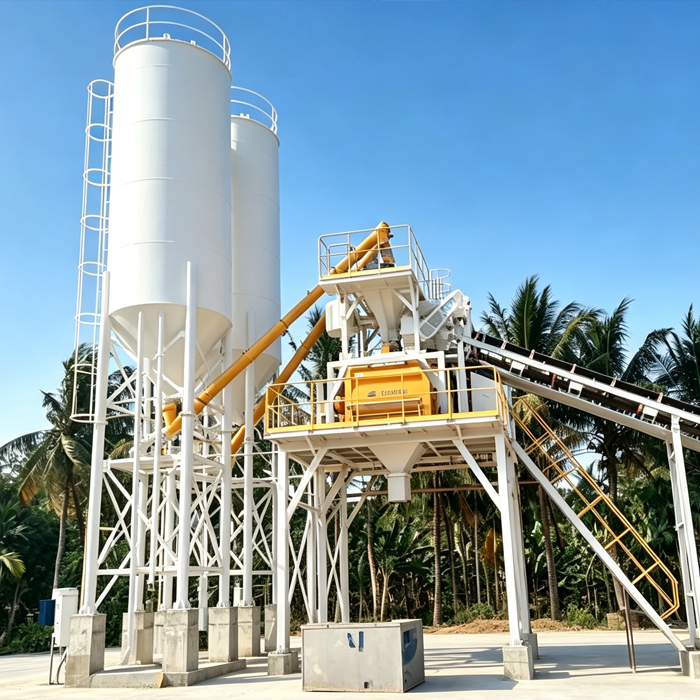
What Is the Decision Between a Steel Bin and a Ground-Level Aggregate Batching Station?
A steel bin aggregate batching station stores aggregate in steel bins, discharges it into a weighing hopper, and transfers the weighed aggregate to the mixer, commonly with an inclined belt conveyor. A ground-level aggregate batching station keeps aggregate storage or receiving at grade and may use aggregate bins or a ground bunker; material then moves through a horizontal conveyor and an inclined conveyor before reaching the mixer. In this article, ground-level means an at-grade aggregate batching arrangement, not a steel bin raised on a structural frame.
The distinction matters because both layouts can appear under the same broad product category of concrete mixing plant. A buyer comparing quotations may see similar mixer capacity, similar weighing accuracy and similar control systems, yet the two offers can differ in truck access, foundation scope, conveyor length, dust-control points and future relocation work. The layout should therefore be selected before the equipment list is fixed.
Why the Layout Decision Matters in a Concrete Mixing Plant
The aggregate batching station is the front end of the concrete mixing plant. It determines how raw aggregate enters the process, how much site area is occupied by storage and transfer equipment, and how the conveyor route interacts with foundations, roads and the main mixing tower. A steel bin layout concentrates aggregate storage in bins and uses an inclined conveyor to lift material. A ground-level layout spreads the receiving and horizontal transfer function at grade, then lifts material with an inclined conveyor.
That difference affects more than steel tonnage. It changes the civil-work package, the number of transfer points that need dust control, the space needed for wheel loaders or trucks, and the installation sequence. For a project with a tight plot, the steel bin route may be easier to fit. For a large ready-mix site with at-grade aggregate receiving and high-volume commercial flow, the ground-level route may match the operating pattern better. Neither conclusion is automatic; both must be checked against the site plan.
Industry Background: Why Both Layouts Remain in Use
The broader concrete batching plant market was valued at USD 3.8 billion in 2024, according to Global Market Insights. Credence Research reports that Asia-Pacific accounted for a 38% revenue share of the global concrete batch plants market in 2024. These figures describe the market context, not the superiority of one layout. They explain why buyers in different regions continue to request both steel bin and ground-level configurations: the equipment must match local site conditions, aggregate supply patterns and project schedules.
Terminology also matters when comparing offers. ISO 19720-1:2017 establishes terminology and commercial specifications for concrete mixing and batching plants. A clear technical comparison should therefore use consistent terms for aggregate bins, ground bunkers, belt conveyors, weighing hoppers and mixing units. Hangzhou Jusheng machinery and equipment co.,ltd (DKTEC) is a China-based manufacturer established in 2015 that specializes in concrete batching plants. Its facility covers 120,000 m², employs about 430 staff and has an annual production capacity of 2,000 units. DKTEC's reference configurations include both steel bin aggregate batching stations and aggregate bin or ground-level batching arrangements, which makes the layout comparison practical rather than theoretical.
How a Steel Bin Aggregate Batching Station Works
A steel bin aggregate batching station uses steel bins as the aggregate storage interface. In DKTEC's reference configuration for small-to-medium engineering projects, the matched equipment includes a steel bin aggregate batching station with 10 m³ × 4 bins, a 650 mm chevron inclined belt conveyor with rain cover, and a 1 m³ twin-shaft mixer. The bins discharge into a weighing hopper; the weighed aggregate is then lifted by the inclined belt to the mixer. The same reference lists a sand silo anti-clogging device and a wear-resistant discharge hopper.
Other DKTEC engineering references show how the steel bin pattern scales. The HZS60G lists four independent 10 m³ aggregate bins with a 2.4 m³ weighing hopper, anti-fall protection, and a 650 mm inclined belt conveyor with rain cover and double-sided walkways. The HZS120G lists four 16 m³ high-capacity aggregate bins with independent 2.0 m³ weighing hoppers, a double-door coarse-and-fine weighing structure, anti-fall protection, and sand bin anti-blocking devices. Its conveyor system uses 800 mm horizontal and inclined belts with double-sided maintenance walkways, head water-flushing devices and full-coverage guards.
The steel bin layout is common in DKTEC's airport, bridge, expressway and high-speed railway references. Those configurations pair a steel bin aggregate batching station with an inclined belt conveyor, cement and admixture weighing systems, a main tower dust removal system, a control room and electrical systems. Optional steel structure foundations are also listed for some engineering scenarios to reduce civil engineering costs. The layout is therefore associated with engineered concrete production where aggregate storage, weighing and inclined feeding are combined in a structured front end.
How a Ground-Level Aggregate Batching Station Works
A ground-level aggregate batching station keeps the aggregate receiving and storage interface at grade. DKTEC's large-scale commercial reference lists an aggregate bin or ground bunker batching station with horizontal and inclined belt conveyors, a main mixing unit, metering systems for cement, supplementary cementitious materials, water and admixtures, a main tower dust removal system, a control room and electrical and monitoring systems. Material is received at grade, transferred horizontally and then lifted by an inclined conveyor to the mixer.
The HZS120 commercial concrete batching plant lists four 16 m³ aggregate silos with anti-blocking devices and 800 mm belt conveyors. The HZS240 lists four 30 m³ underground bunker silos, 1000 mm conveyors with double-sided maintenance walkways, and video surveillance at the belt tail and discharge port. These examples show that ground-level or bunker-based aggregate storage can be part of a highly configured commercial plant, not a simplified alternative.
The ground-level pattern is closely tied to large and extra-large commercial ready-mix production. DKTEC's extra-large commercial reference describes a fully enclosed standby hopper with a forced-cleaning membrane bag filter, optional dual-plant control and smart silo level monitoring. In such plants, the aggregate front end must support continuous high-volume production and a steady flow of mixer trucks. The horizontal conveyor section becomes part of that operating rhythm, while the inclined conveyor performs the final lift to the mixing tower.
Material Flow: The Real Difference Between the Two Layouts
The clearest way to compare the two layouts is to follow the aggregate. In a steel bin station, the path is: aggregate delivery, steel bin storage, gravity discharge to the weighing hopper, inclined belt conveyor, mixer. The bin elevation provides the vertical drop needed for weighing, and the inclined conveyor provides the final rise. The layout concentrates storage and weighing in one raised structure.
In a ground-level station, the path is: aggregate delivery, at-grade bin or ground bunker, horizontal belt conveyor, inclined belt conveyor, weighing interface, mixer. The additional horizontal transfer is the defining feature. It can improve the fit between the aggregate yard and the mixing tower, but it also adds conveyor length, transfer points and maintenance access requirements. DKTEC's expressway reference states that seamless material flow technology prevents aggregate spillage, ensures continuous supply and improves conveying efficiency by 20%. That statement is about material-flow design, not about one layout being universally faster.
For a buyer, the decision rule is simple: draw the aggregate path on the site plan. If the path requires a long horizontal run before the incline, a ground-level arrangement may match the yard. If the path can be concentrated into a raised bin structure with a direct inclined feed, a steel bin arrangement may be easier to control. The answer depends on the site, not on a generic preference.
Footprint and Site Planning
Footprint is often the first constraint that eliminates one option. A steel bin layout concentrates aggregate storage in bins and creates an inclined conveyor envelope. A ground-level layout uses at-grade storage or receiving area and adds a horizontal conveyor run. The steel bin layout can reduce the plan area needed for aggregate receiving, but it requires structural support and safe access around the bins and inclined conveyor. The ground-level layout can simplify truck or loader access at grade, but it may require more plan length for the horizontal transfer and more attention to traffic circulation.
Site planning should also consider the main tower, control room, powder silos, weighbridge, workshop and truck turning circle. A layout that looks compact on an equipment drawing can become congested when maintenance walkways, fire access and aggregate stockpiles are added. DKTEC's HZS60G reference includes double-sided walkways on the inclined belt; the HZS120G includes double-sided maintenance walkways on the 800 mm horizontal and inclined belts; the HZS240 includes 1000 mm conveyors with double-sided maintenance walkways. These details show why the conveyor route must be planned as an operating space, not only as a line on a drawing.
Modular Installation and Relocation Considerations
Both layouts can be modular, but the modular sequence differs. DKTEC's HZS60G reference describes a four-layer module design, sub-module preassembly and overall lifting to reduce the number of components installed on site. Its steel bin and inclined conveyor arrangement is therefore not necessarily a slow site-build option. The commercial plant reference states that modular design cuts on-site installation workload by 20%, and some engineering scenarios list an optional steel structure foundation to reduce civil engineering costs.
For a ground-level station, the horizontal conveyor and at-grade receiving area become part of the modular plan. The installation team must align the horizontal belt, the inclined belt, the weighing interface and the mixer. If the site has a ground bunker, the civil scope becomes more significant and must be completed before equipment erection. If the site uses aggregate bins at grade, the interface is different but still requires a clear foundation and access plan. In both cases, factory preassembly and a defined module sequence reduce rework.
Relocation deserves separate attention. A stationary steel bin plant can be dismantled and rebuilt, but the structural connections, foundations and conveyor supports must be designed for that possibility. A ground-level plant with a bunker is less likely to be relocated without major civil work. Buyers who expect to move the plant should state that requirement before the layout is fixed; the mobile concrete batching plant range is a separate solution and should not be confused with a stationary ground-level layout.
Step-by-Step Buyer Decision Framework
- Map the aggregate path. Mark the truck entrance, aggregate stockpile, receiving point, weighing hopper, conveyor route and mixer on the site plan. Compare a steel bin path with a ground-level path before reviewing equipment prices.
- Confirm the aggregate storage method. Decide whether aggregate will be stored in steel bins, at-grade bins or a ground bunker. Check bin volume, anti-blocking provisions and discharge reliability for the aggregate types used.
- Check the conveyor route. A steel bin layout commonly uses an inclined conveyor. A ground-level layout commonly uses horizontal plus inclined conveyors. Confirm belt width, walkways, rain cover, guards and water-flushing provisions where relevant.
- Match the weighing system. DKTEC HZS specifications list aggregate accuracy of ±2% and cement, water and additive accuracy of ±1% across multiple models. The layout should not be allowed to undermine the weighing performance; check hopper size, coarse-and-fine weighing and anti-fall protection.
- Review civil works. For a steel bin station, check the bin support structure and the optional steel structure foundation. For a ground-level station, check the at-grade foundation, bunker scope if used, and the horizontal conveyor supports.
- Plan installation and access. Confirm module count, lifting plan, maintenance walkways and control room location. A layout that is efficient in production but difficult to maintain is not a good layout.
- Check dust, noise and enclosure requirements. Both layouts need dust control at transfer points and around the mixer. DKTEC references list main tower dust removal systems and enclosed structures; the final scope must match local requirements.
- Validate with a layout review. Before ordering, overlay the proposed plant on the site plan and review it with the supplier. DKTEC's one-stop service chain includes customized solutions, equipment delivery, installation and commissioning, and lifelong maintenance.
Use Cases: When Each Layout Fits
A steel bin aggregate batching station is a practical fit for engineered concrete projects where the plant must produce multiple concrete grades and the aggregate front end can be organized around raised bins and an inclined feed. DKTEC's airport, bridge, expressway and high-speed railway references use steel bin batching stations with inclined belt conveyors. The small-to-medium engineering reference with 10 m³ × 4 bins shows that the layout is not limited to very large plants. The HZS60G and HZS120G engineering plants show how the steel bin pattern can be combined with different mixer sizes, weighing hoppers and belt widths.
A ground-level aggregate batching station is a practical fit for large and extra-large commercial ready-mix plants where aggregate receiving, stockpiling and horizontal transfer are part of the daily operating pattern. DKTEC's commercial references list aggregate bins or ground bunker batching stations with horizontal and inclined belt conveyors. The HZS120, HZS240 and HZS270 family shows how commercial plants can be configured with different aggregate storage arrangements, conveyor widths and weighing capacities. The ground-level layout is therefore not a low-capability choice; it is a different material-flow choice.
Comparison Table: Steel Bin vs Ground-Level Aggregate Batching Station
| Decision area | Steel bin aggregate batching station | Ground-level aggregate batching station |
|---|---|---|
| Typical aggregate storage | Steel bins. DKTEC small-to-medium engineering reference: 10 m³ × 4 bins. HZS120G reference: four 16 m³ high-capacity aggregate bins. | Aggregate bins or ground bunker at grade. HZS240 reference: four 30 m³ underground bunker silos. |
| Material flow | Bin discharge to weighing hopper, then inclined belt conveyor to mixer. | At-grade receiving, horizontal belt conveyor, then inclined belt conveyor to mixer. |
| Conveyor example | 650 mm chevron inclined belt with rain cover in the HZS60G reference; 800 mm horizontal and inclined belt on the HZS120G reference. | 800 mm belt conveyors on the HZS120 reference; 1000 mm conveyors with double-sided walkways on the HZS240 reference. |
| Weighing | HZS60G: 2.4 m³ weighing hopper. HZS120G: independent 2.0 m³ weighing hoppers. HZS specifications list aggregate ±2% and cement, water and additive ±1%. | HZS specifications also list aggregate ±2% and cement, water and additive ±1%. Confirm hopper type, belt width and discharge interface. |
| Footprint logic | Concentrates aggregate storage in raised bins and an inclined conveyor envelope. | Uses an at-grade storage or receiving area plus horizontal and inclined conveyor runs. |
| Civil works | Optional steel structure foundation can reduce civil engineering costs in some DKTEC engineering references. | Ground bunker variants add at-grade or below-grade civil scope; confirm foundation and drainage design. |
| Modular installation | Preassembled modules and inclined conveyor. The HZS60G reference uses a four-layer module design, sub-module preassembly and overall lifting. | Modular commercial design with factory pre-assembly; horizontal and inclined conveyor modules must be aligned. |
| Project fit | Airport, bridge, expressway, high-speed railway and small-to-medium engineering references. | Large and extra-large commercial ready-mix references. |
| Decision trigger | Choose when raised aggregate storage and a concentrated inclined feed route fit the site and project type. | Choose when at-grade aggregate receiving and high-volume commercial flow define the site and operating pattern. |
What Buyers Should Not Assume
Do not assume that a steel bin layout is always more accurate. DKTEC HZS specifications list the same aggregate accuracy class of ±2% and the same cement, water and additive accuracy class of ±1% across multiple models. Accuracy depends on the weighing system, calibration and maintenance, not on whether the bin is steel or at grade. The layout affects material flow and site fit, but it does not replace a properly specified weighing package.
Do not assume that a ground-level layout is always cheaper. A ground bunker can add civil work, drainage and access requirements. A steel bin layout can require structural steel and an inclined conveyor envelope. The correct budget comparison is the total installed scope: foundations, conveyors, dust control, electrical works, installation and commissioning. DKTEC's optional steel structure foundation and modular design facts are cost drivers to discuss, not a universal price ranking.
Do not assume that more aggregate bins automatically solve every problem. Bin volume must match the aggregate types, delivery frequency and batch cycle. The HZS60G uses four 10 m³ bins; the HZS120G uses four 16 m³ bins; the HZS240 uses four 30 m³ underground bunker silos. Each configuration belongs to a different plant scale and project pattern. The right question is whether the storage and discharge system matches the concrete mix schedule, not whether the bin number looks impressive on a specification sheet.
Frequently Asked Questions
Does the layout choice change the compliance documentation for a concrete mixing plant?
The core plant documentation remains necessary, but the layout changes which items must be shown: structural foundations, conveyor guards, transfer-point dust control, electrical rooms and site permits. ISO 19720-1:2017 provides terminology and commercial specifications for concrete mixing and batching plants. The final compliance file should identify the plant configuration, conveyor arrangement, dust-control provisions and electrical system for the actual site.
Can a ground-level batching station handle the same aggregate varieties and accuracy as a steel bin station?
Layout does not set dosing accuracy by itself. DKTEC HZS specifications list aggregate accuracy of ±2% and cement, water and additive accuracy of ±1% across multiple models. A ground-level station adds a horizontal conveyor and an at-grade receiving interface, so the buyer should verify anti-blocking provisions, weighing hopper size, belt width and discharge reliability for the aggregate types used. The HZS60G steel bin reference uses 10 m³ × 4 bins and a 2.4 m³ weighing hopper; the HZS120G uses four 16 m³ bins and independent 2.0 m³ weighing hoppers.
Which layout requires more civil work and budget?
There is no universal answer without the site plan. A ground bunker variant can add at-grade or below-grade civil scope, while a steel bin layout can use an optional steel structure foundation to reduce civil engineering costs in some DKTEC engineering references. Modular design also affects installation workload: the commercial plant reference states a 20% reduction in on-site installation workload. Compare total installed scope, not a headline equipment price.
How can a buyer validate the layout before ordering?
Use an engineering layout review rather than a generic catalogue comparison. Overlay the proposed plant on the site plan and check truck access, aggregate receiving, stockpile area, conveyor route, foundation, discharge height, control room and maintenance walkways. DKTEC's one-stop service chain includes customized solutions, equipment delivery, installation and commissioning, and lifelong maintenance. Share the site plan and aggregate delivery method with DKTEC for a layout review and quotation.
What affects lead time for a steel bin or ground-level batching station?
The supplied facts do not give a fixed lead time for stationary steel-bin or ground-level plants. Lead time is affected by module count, factory pre-assembly, conveyor length, foundation readiness, site power and control-system scope. The HZS60G reference uses a four-layer module design and sub-module preassembly to reduce on-site installation; the commercial modular design is listed as cutting on-site installation workload by 20%. Confirm the schedule against the final configuration and site plan.
Conclusion: Choose the Layout That Matches the Material Flow
The steel bin versus ground-level decision should be made from the aggregate path outward. A steel bin aggregate batching station fits layouts where raised aggregate storage and a concentrated inclined feed route support the project type, especially in DKTEC's airport, bridge, expressway, high-speed railway and small-to-medium engineering references. A ground-level aggregate batching station fits layouts where at-grade aggregate receiving, horizontal transfer and high-volume commercial ready-mix flow define the operation.
Hangzhou Jusheng machinery and equipment co.,ltd (DKTEC) builds both layout patterns into its concrete mixing plant range. Buyers should compare the plant as a complete system: aggregate storage, weighing, conveyor route, dust control, foundation, installation and future relocation. The right choice is the one that makes the material flow simple, safe and maintainable on the actual site.
Next step: Send your site plan, aggregate delivery method and target concrete grades to DKTEC for a layout review and quotation. Email: linder@dongkunchina.com. Tel/WhatsApp: +86 18888972181. Address: Zhongjiao Fortune Mansion, Gongshu District, Hangzhou, Zhejiang, China. Website: www.dongkunchina.com.
Download the DKTEC concrete batching plant brochure: DKTEC concrete batching plant PDF.
Have Questions or Need More Details?
Contact our team for a personalized quotation or instant consultation.
Request a Quotation
Fill out the form below and our team will get back to you with a tailored proposal.
WhatsApp Direct Chat
Prefer to chat in real-time? Message us on WhatsApp for instant assistance & quick answers.
- Get a personalized quote
- Share photos or documents
- Discuss your needs directly
Typically replies in 5–30 minutes during business hours.