
High-Speed Railway Batching Plant Application Guide: Producing High-Grade Concrete On Site
Application guide for project batching plants · Engineering concrete batching plant series
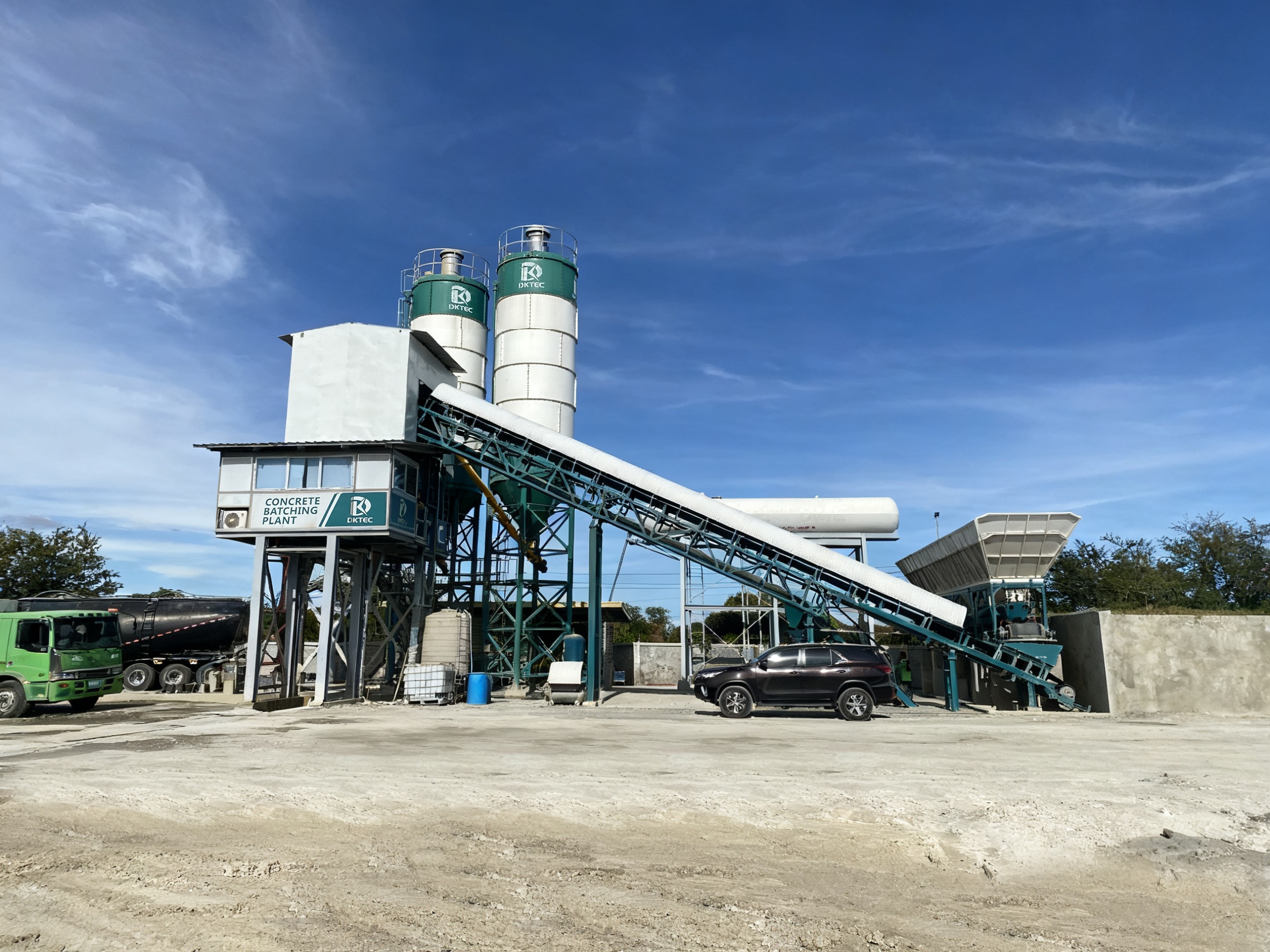
A concrete mixing plant arranged for project-based, on-site production of high-grade concrete.
A high-speed railway batching plant is a project-dedicated concrete mixing plant installed at or close to the alignment, so that high-grade concrete is batched, weighed and mixed on site instead of being hauled in from a distant commercial ready-mix supplier. The equipment brief that follows from that decision is narrower than a general plant purchase: the plant must be assembled quickly on a temporary site, relocated or dismantled when the section is complete, and still hold the batching accuracy that structural concrete requires.
This guide explains how a concrete mixing plant is adapted to that scenario. It covers the four-level modular design that allows integrated hoisting and rapid installation, the dual-stage coarse and fine aggregate metering that governs precision, the supporting equipment around the mixer — a steel bin aggregate batching station with 10 m³ × 4 bins and an inclined belt conveyor carrying a 650 mm chevron belt with rain cover — and the twin-shaft mixer options used to match the plant to the mix design. The reference equipment throughout is the engineering concrete batching plant series built by Hangzhou Jusheng Machinery & Equipment Co., Ltd. (brand: DKTEC), a Hangzhou-based manufacturer of concrete mixing plants and mining equipment founded in 2015.
Problem Definition: What Makes an On-Site Railway Plant Different
The deciding factor on a railway package is not the mixer alone — it is the interval between batching and placement. Structures along an alignment consume concrete in sequenced pours, and the shorter that interval, the less the mixture's workability is exposed to transport variables. Producing on site removes the haul variable: the plant is sized to the pour schedule and positioned inside the section it serves.
Four constraints then shape the equipment brief:
- Site conditions. Railway batching sites are temporary and often constricted. There is rarely room for a full permanent-plant layout with a long aggregate storage yard, so the plant footprint, foundation plan and assembly sequence all have to be resolved in advance.
- Material variance. Aggregates are normally sourced locally, and grading and moisture change between stockpiles. The weighing system, not the mix design sheet, is what absorbs that variance.
- Grade consistency. High-grade mixes leave little margin for drift in cementitious content or water. In the engineering series described below, aggregate weighing is held to ±2% and cement, mixing powder, water and additive weighing to ±1% — that tolerance is the quality control point of the whole plant.
- Schedule pressure. Installation and commissioning must be short so that production can start, and the plant must sustain continuous output through long pours rather than peak for a single batch.
Engineering concrete batching plants are built around exactly these conditions. They are widely used in high-speed railways, highways, bridges and airports, and their design concept is usually summarised as high precision, high strength and high adaptability — three properties that map directly onto the four constraints above.
Industry Background: Demand, Standards and Supply Base
Concrete batching equipment sits inside a large and geographically concentrated supply chain. Global Market Insights valued the global concrete batch plants market at USD 3.8 billion in 2024, while Credence Research reports that Asia-Pacific accounted for a 38% revenue share of that market in the same year. China remains a major equipment source: UN Comtrade / WITS data records USD 276.9 million of concrete or mortar mixer exports (HS 847431) from China in 2023.
Within that demand picture, project-driven supply is a distinct segment. Global Market Insights also reports that the infrastructure segment accounted for 39.4% of the mobile concrete batch plant market in 2024 — a reminder that a significant share of batching capacity is bought for defined construction packages rather than for permanent commercial production.
Two reference points are useful when writing a technical specification. ISO 19720-1:2017, published by ISO on 22 June 2017, establishes terminology and commercial specifications for concrete mixing and batching plants; it is the document project specifications typically point to when plant terms and commercial data must be stated consistently. On the manufacturing side, DKTEC records that Hangzhou Jusheng Machinery & Equipment Co., Ltd. transitioned from trading to robot-assisted production of mixing stations in 2017 — a shift that matters to buyers evaluating repeatability across repeated orders rather than a single machine.
Detailed Solution: How the Plant Adapts to the Railway Site
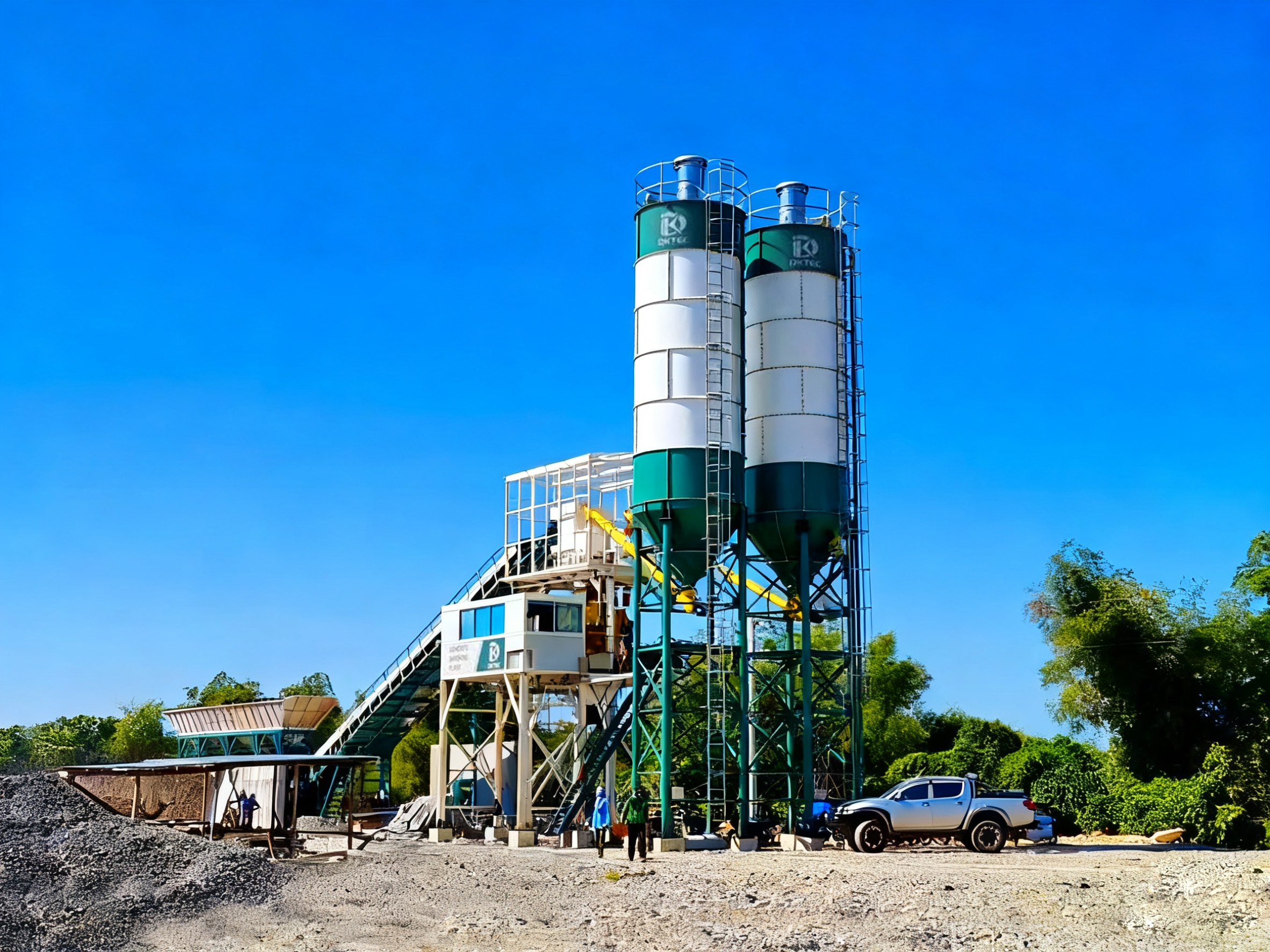
Plant sections are arranged so that transport, hoisting and assembly follow a defined sequence.
1. Four-level modular design: integrated hoisting and rapid installation
The plant is organised as four structural levels, each delivered as a liftable module rather than as loose components to be assembled piece by piece. The practical consequence on a railway site is that hoisting and installation become one integrated operation: the modules arrive as transportable units, are lifted into position in sequence, and are connected on their foundation pads. Because the levels are separated by function — storage and batching at the top, weighing below it, mixing at the base, and the discharge level at grade — the heaviest assembly work happens at ground level before hoisting, not at height. On a temporary site with a short possession window, that sequence is what turns an installation schedule into days rather than weeks, and it also makes later dismantling and relocation to the next section a planned operation rather than a dismantling project.
2. Dual-stage coarse and fine aggregate metering
Aggregate is the largest component in the mix by mass, so it is also the component where a single-stage feed is most easily thrown off by a heavy, fast-flowing charge. In a dual-stage arrangement, the coarse discharge brings the weigh hopper close to the target quickly, and the fine stage then completes the remainder at a reduced rate and closes the gate on the final value. The result is that the weighing cycle ends near the set point instead of overshooting and correcting.
This matters for high-grade concrete because aggregate error propagates into the water and cementitious balance. In the HZS G-series engineering plants, aggregate weighing is specified at ±2% across the model range, while cement, mixing powder, water and additive are each held at ±1%. Under local aggregate sourcing conditions — where stockpile moisture and grading shift from delivery to delivery — that split of tolerances, combined with the two-stage feed, is what keeps successive batches of the same grade consistent.
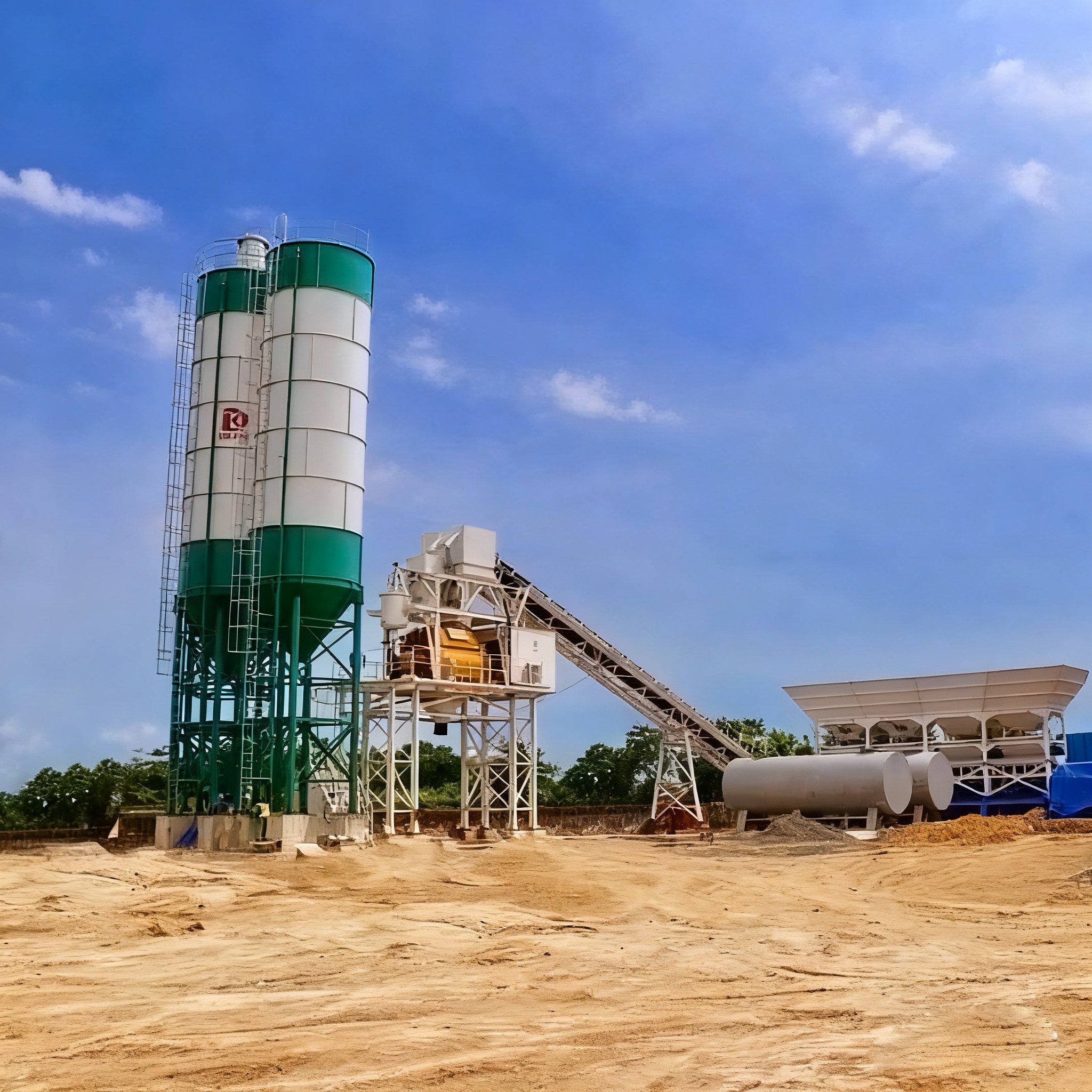
Aggregate batching and weighing section — where coarse and fine metering accuracy is set.
3. Steel bin aggregate batching station: 10 m³ × 4 bins
Aggregate storage on a railway site has to serve two purposes at once: hold enough material to keep a long pour moving, and separate the gradings that the mix design calls for. A steel bin aggregate batching station with four bins of 10 m³ each provides that separation, so coarse and fine fractions can be charged independently and the two-stage metering described above has something to meter from. Steel bins also suit project conditions better than cast in-situ storage walls: they arrive as part of the modular delivery, sit on a simpler foundation, and can be relocated with the rest of the plant when the section is finished.
For buyers comparing project plants, the bin configuration is one of the clearest points of customisation. Custom aggregate storage, custom bins and custom control configurations are all available within the OEM scope, which means the number and size of bins can follow the actual mix designs of the package rather than a catalogue default.
4. Inclined belt conveyor: 650 mm chevron belt with rain cover
Between the batching station and the mixer, the inclined belt conveyor is the component most exposed to weather. A 650 mm chevron belt is used on the incline so that material is carried on the belt's raised profile rather than sliding back on a smooth surface during a wet or dusty charge; the rain cover over the conveyor protects that carrying surface and the material from direct rainfall. On a site where production continues across a long construction season, keeping the aggregate feed path covered is a maintenance decision as much as a quality one: less water ingress on the belt means less variation arriving at the weigh hopper, and fewer stoppages for cleaning.
5. Twin-shaft mixer options and mixer selection
The mixer determines how the metered materials leave the plant. Twin-shaft mixers are widely used for ready-mix concrete and large-scale concrete production because they provide fast, intensive mixing with high throughput — which is why they are the usual starting point for a project plant feeding sequenced pours. Planetary mixers, by contrast, are used where excellent mixing uniformity is the priority, including precast concrete, dry concrete and special concrete.
DKTEC can configure SICOMA, BHS or other suitable mixer options according to the concrete type, the required output and the project requirements. For a railway package, the decision rule is straightforward: high-volume structural supply normally points to a twin-shaft mixer, while a special or very high-uniformity mix may justify a planetary unit. This is a decision to be settled at specification stage, because the mixer selection drives nominal capacity and installed power for the whole plant.
6. Stationary or mobile, and how much automation to specify
Project plants are not a single machine type. A stationary concrete batching plant is designed for long-term operation at a fixed location and suits high-volume production; a mobile or portable plant is designed for faster installation, relocation and flexible production at different job sites. The appropriate choice depends on project duration, required output, relocation frequency and site conditions — a section with a single long-term casting yard generally suits a fixed plant, while work that follows the alignment in short segments is better served by mobile units such as the HZS25Y to HZS120Y models in the range.
Automation is the second specification decision. A recorded configuration for a highway package, for example, consists of a stationary twin-shaft plant with four aggregate bins, three cement/powder silos, belt conveyor feeding, an automatic control system and 400V/50Hz/3Ph power, with the layout adjusted to site conditions. That list is a useful template for a railway enquiry: capacity, mixer type, bin count, silo count, feed method, power supply and automation level are the variables that a supplier needs before a layout can be proposed.
Step-by-Step Breakdown: From Requirement to Production
- Establish the actual hourly requirement, not the theoretical one. Capacity selection should be based on concrete demand, project type, working hours, peak production requirements and transportation distance. As a practical reference, small construction projects typically fall in the 25–60 m³/h band, commercial ready-mix concrete in the 60–180 m³/h band, and large infrastructure projects above 120 m³/h, extending past 270 m³/h. The recommendation is to choose on actual hourly production requirement and expected utilisation rate rather than on the headline figure alone.
- Select the model and mixer together. In the engineering series this means matching HZS60G, HZS90G, HZS120G or HZS180G to the pour schedule and then confirming twin-shaft or planetary mixing.
- Fix the customisation scope. Custom aggregate storage, custom bins and custom control configurations, plus voltage and frequency, company logo, machine colour, appearance design and branding where required.
- Resolve site layout and foundation before delivery. Foundation pads, module positions, aggregate bin placement and conveyor incline all need to be agreed so that hoisting can proceed on arrival.
- Calibrate the weighing system and complete acceptance. Weighing accuracy should be verified against the specified tolerances, and pre-shipment testing is the agreed acceptance criterion before the equipment leaves the factory.
- Commission on site and start production. Remote support and on-site installation support are both available, so calibration can be repeated under actual site conditions with the local aggregates in the bins.
Use Cases: Plants Already Running on Infrastructure Packages
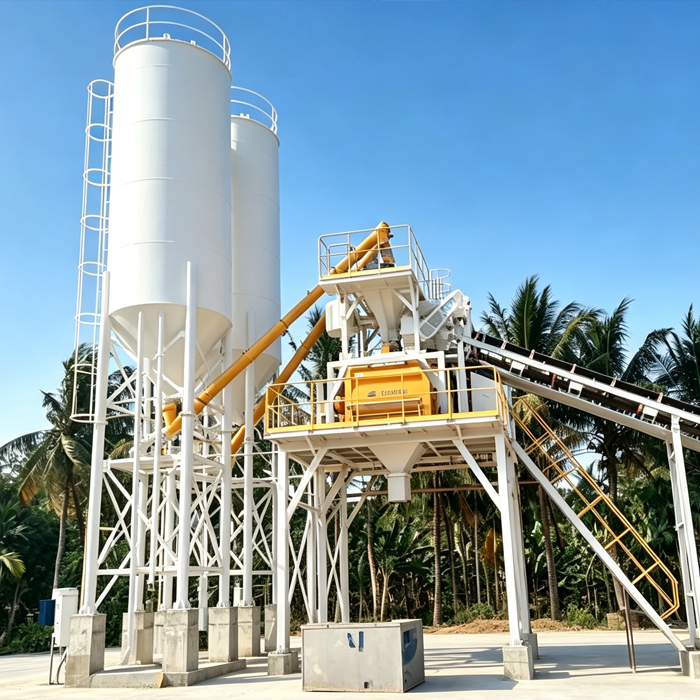
HZS90G engineering concrete batching plant, one of the models used for project-based concrete supply.
Large construction contractor, Indonesia — HZS300. A single unit with 300 m³/h capacity was supplied for large-scale infrastructure projects. The operating record cites high-volume production, stable operation and consistent quality, with high-efficiency mixing, precise weighing and reliable performance. Units of this class typically run over a 10–15 year service life.
Large construction contractor, Oman — HZS240. A 240 m³/h plant supplied for large-scale infrastructure projects, with the same service profile: efficient mixing, precise weighing and consistent output over a 10–15 year horizon.
Concrete supplier, Philippines — HZS180 for bridge works. This plant serves bridge engineering, providing a stable concrete supply for pile foundations, pile caps, piers, abutments and girder bodies. Reported results are high-efficiency production, stable operation and reliable concrete quality, with a low failure rate and convenient maintenance. This is the case most directly relevant to railway structures, because the elements listed are of the same type as those cast on elevated alignments.
Ready-mix concrete supplier, Philippines — two units of HZS90G. Two engineering plants were supplied for commercial concrete production, with stable operation and consistent concrete quality attributed to high efficiency and precise weighing.
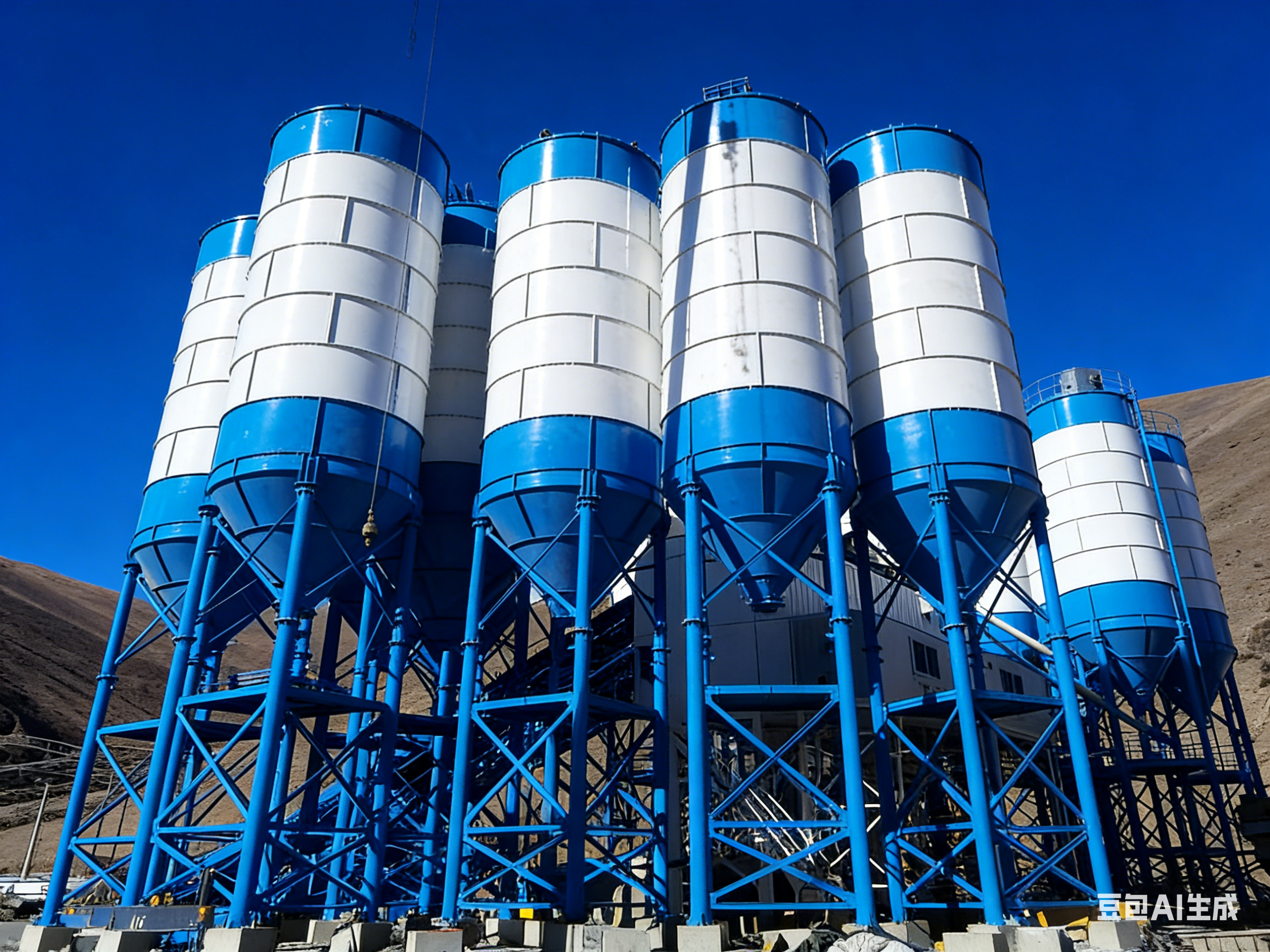
High-capacity configuration for large-scale infrastructure concrete supply.
Comparison Table: Engineering Series Model Selection
| Model | Theoretical productivity | Nominal capacity | Aggregate weighing range & accuracy | Cement weighing range & accuracy | Water / additive accuracy |
|---|---|---|---|---|---|
| HZS60G | 60 m³/h | 1000 L | 600–2500 kg ±2% | 100–700 kg ±1% | ±1% |
| HZS90G | 90 m³/h | 1500 L | 600–2000 kg ±2% | 200–1200 kg ±1% | ±1% |
| HZS120G | 120 m³/h | 2000 L | 600–2000 kg ±2% | 200–1200 kg ±1% | ±1% |
| HZS180G | 180 m³/h | 3000 L | 900–3000 kg ±2% | 300–1800 kg ±1% | ±1% |
Parameters as published for the engineering concrete batching plant series. All four models share a minimum unloading height of ≥3.8 m and provide a dedicated mixing powder weighing channel in addition to cement.
Comparison Table: Procurement and Supply Terms for Customised Orders
| Item | Stated detail |
|---|---|
| Minimum order quantity | 1 unit, applying to OEM and customised orders, including custom aggregate storage, custom bins and custom control configurations |
| Models covered by the 1-unit MOQ | HZS25Y, HZS35Y, HZS60Y, HZS90Y, HZS120Y, HZS60G, HZS90G, HZS120G, HZS180G, HZS120, HZS180, HZS240, HZS270, HZS300 |
| Trial orders | Single-unit trial orders are allowed before bulk purchasing |
| Delivery terms | FOB or CIF |
| Acceptance criteria | Pre-shipment test |
| Payment terms | 30% down payment by T/T, full payment before delivery |
| Lead time | 25–60 days |
| Monthly capacity | 50 units |
| Quality control | 100% test |
| After-sales | Remote support and on-site installation support |
| Customisation options | Voltage and frequency, company logo, machine colour, appearance design and branding; OEM and ODM production services both available |
FAQ
Is there a recognised standard for batching plant terminology and specifications?
ISO 19720-1:2017 establishes terminology and commercial specifications for concrete mixing and batching plants and was published by ISO on 22 June 2017. It is the reference document used when plant terminology and commercial data must be stated consistently in a project specification. It covers terminology and commercial specifications; it is not a machine certification.
Can an OEM stationary concrete batching plant be supplied with custom aggregate storage for a railway project?
Yes. OEM and ODM production services are both available, with OEM production services offered for customised orders and ODM design and production services offered alongside OEM manufacturing. The 1-unit minimum order quantity applies to OEM and customised orders, including customised aggregate storage, custom bins and custom control configurations. Customised options cover voltage and frequency, company logo, machine colour, appearance design and branding, and the 1-unit MOQ applies across models HZS25Y, HZS35Y, HZS60Y, HZS90Y, HZS120Y, HZS60G, HZS90G, HZS120G, HZS180G, HZS120, HZS180, HZS240, HZS270 and HZS300.
What are the purchasing terms for a customised project plant?
OEM concrete batching plant orders follow the same transaction terms as standard orders: 1 unit minimum order quantity, FOB or CIF delivery, pre-shipment test acceptance, and 30% T/T down payment with full payment before delivery.
Can a single unit be ordered first as a trial before a larger commitment?
Yes. The 1-unit minimum order quantity is specifically structured to allow single-unit trial orders before bulk purchasing, and the same term applies to OEM or customised orders. For a railway package, that means one plant can be delivered, installed, calibrated against the project's own aggregates, and evaluated in production before further units are added to the section or to the wider programme.
What lead time and production capacity should be planned?
Lead time is 25–60 days, and monthly capacity is 50 units, with 100% testing before shipment and both remote support and on-site installation support after delivery. Because the plant is normally on the critical path of the casting programme, lead time should be confirmed against the first scheduled pour, not against the contract signature date. To check whether a configuration suits your site, request a quotation with your required hourly output, mix types, bin and silo counts, power supply and layout constraints — a sample configuration proposal and the current product catalogue are available on request.
Conclusion
Adapting a concrete mixing plant to a high-speed railway batching plant scenario is mostly a question of resolving four things in the right order. The four-level modular design makes hoisting and installation an integrated operation, so a temporary site can be brought into production quickly and relocated with the work. Dual-stage coarse and fine aggregate metering, held within ±2% on aggregate and ±1% on cement, mixing powder, water and additive, keeps high-grade concrete consistent when aggregates come from local stockpiles. The steel bin aggregate batching station with 10 m³ × 4 bins and the inclined belt conveyor with a 650 mm chevron belt and rain cover protect that accuracy from storage variability and weather. And the choice between twin-shaft and planetary mixers settles the plant's throughput profile before the layout is drawn.
Hangzhou Jusheng Machinery & Equipment Co., Ltd. (DKTEC) manufactures this series in Hangzhou, with a 120,000 m² facility, 430 employees, an 80-engineer R&D team and an annual output of 2,000 units, and exports to the Middle East, Southeast Asia, Africa, Europe, Central Asia, West Asia, Australia and South America. Engineering plants from the HZS G-series and the wider HZS range are supplied with a 1-unit minimum order quantity, a 25–60 day lead time and support for OEM or ODM customisation.
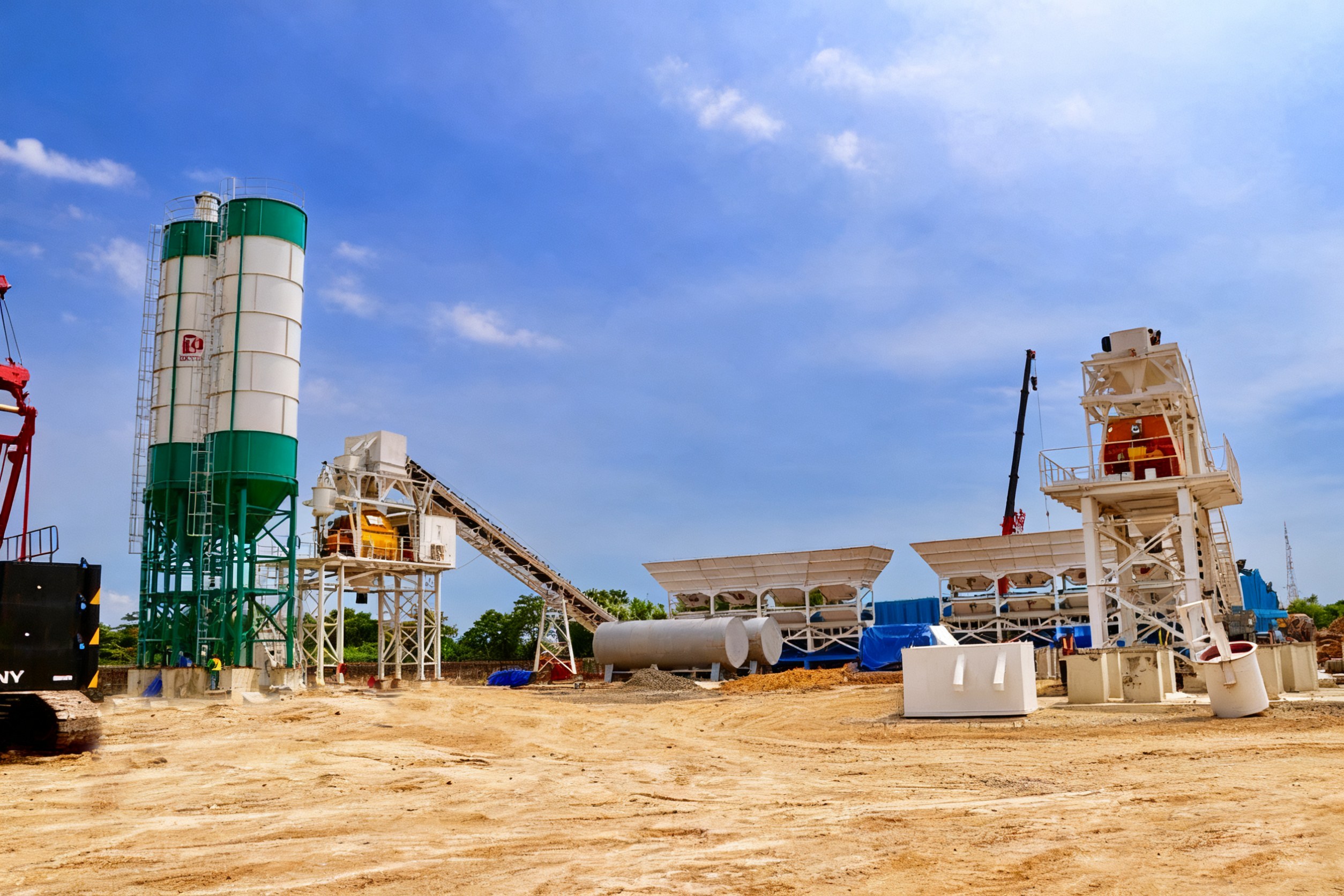
Request a configuration proposal matched to your pour schedule, aggregate grades and site layout.
Next step: sample configuration and quotation
Send your required hourly output, mix types and site constraints to receive a configuration proposal for your project. The full product catalogue can be downloaded here: DKTEC concrete batching plant brochure (PDF).
Contact: Linder · Email: linder@dongkunchina.com · Tel / WhatsApp: +86 18888972181
Website: www.dongkunchina.com · Blog: blog.dongkunchina.com
Have Questions or Need More Details?
Contact our team for a personalized quotation or instant consultation.
Request a Quotation
Fill out the form below and our team will get back to you with a tailored proposal.
WhatsApp Direct Chat
Prefer to chat in real-time? Message us on WhatsApp for instant assistance & quick answers.
- Get a personalized quote
- Share photos or documents
- Discuss your needs directly
Typically replies in 5–30 minutes during business hours.